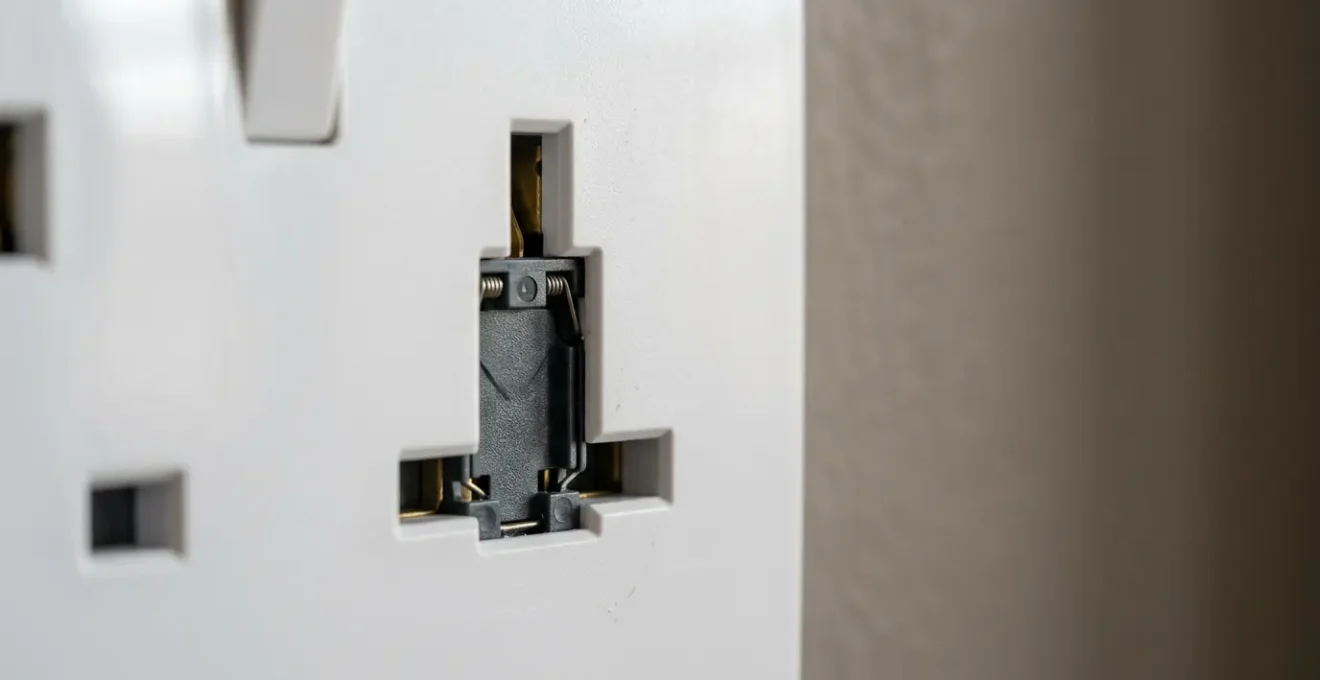
Contrary to popular belief, plastic socket protectors do not make UK electrical outlets safer; they actively defeat their world-class, built-in safety features and can create new, hidden dangers.
- British BS 1363 sockets are already child-safe by design, featuring an automatic shutter system that prevents access to live parts.
- Official bodies, including the NHS and the Department of Health, have issued alerts advising against the use of these protectors because they can damage the socket and override its safety mechanism.
Recommendation : Remove and discard all plug-in socket covers immediately. Focus babyproofing efforts on genuine electrical hazards like trailing cables, overloaded extensions, and accessible appliances.
As a new parent in the UK, walking down the baby-proofing aisle can be overwhelming. Among the corner guards and cupboard locks, one item seems like a non-negotiable purchase: the simple plastic socket protector. The logic feels irrefutable—plugging a perceived hole to stop tiny, curious fingers from getting an electric shock. It’s an act driven by love and a desire to create a perfectly safe environment. This belief is so ingrained that questioning it seems irresponsible.
However, what if this common practice is not just unnecessary but actively dangerous? What if these cheap plastic plugs are a form of « safety theatre, » a gesture that feels protective but in reality introduces risks where none existed? The uncomfortable truth is that the UK’s electrical system is one of the safest in the world, precisely because child safety is engineered directly into the socket itself. Adding a third-party, unregulated piece of plastic doesn’t enhance this system; it compromises it.
This article debunks the pervasive myth of the socket protector. We will explore the inherent safety of the British BS 1363 plug and socket standard, examine why official health and safety bodies vehemently advise against these covers, and redirect your focus to the genuine electrical risks that truly warrant your attention. By the end, you will understand why the safest thing you can do for your electrical outlets is to leave them well alone.
Table of contents: Why Socket Protectors Might Make UK Electrical Outlets More Dangerous
- How British BS 1363 Sockets Are Already Child-Safe Without Plastic Covers?
- Why Trading Standards and the NHS Advise Against Socket Covers?
- Which Electrical Risks Actually Threaten Toddlers in UK Homes?
- How Some Socket Protectors Actually Open the Safety Shutters for Children?
- Why Managing Trailing Cables and Accessible Appliances Matters More Than Socket Covers?
- Why Your Beautiful Second-Hand Cot Might Fail Current British Safety Standards?
- How to Audit Each Room for Hazards Using a 50-Point Safety Checklist?
- Why Babyproofing at 3 Months Prevents the A&E Visit at 7 Months?
How British BS 1363 Sockets Are Already Child-Safe Without Plastic Covers?
To understand why socket covers are redundant and hazardous in the UK, one must first appreciate the genius of the BS 1363 socket. This standard isn’t a recent innovation; it was a core part of Britain’s post-war reconstruction, with the BS 1363 system being introduced back in 1947. Safety was paramount from its inception. Unlike many international socket designs, the UK model was specifically engineered to prevent accidental electrocution, particularly for children.
The key to this inherent safety is a mandatory, non-negotiable feature: an internal shutter system. The two lower holes, which connect to the live and neutral pins, are physically blocked by spring-loaded plastic shutters. These shutters can only be opened when the longer, top earth pin of a standard UK plug is inserted first. This earth pin acts like a key, pushing down a lever that simultaneously opens the shutters for the other two pins. Without this ‘key’, the live contacts remain inaccessible.
This means it is physically impossible for a child to poke a single object, like a crayon or a finger, into the dangerous parts of the socket. According to the Institution of Engineering and Technology, the standard is incredibly robust. As they clarify, « The Standard requires that an interlocking shutter system stops foreign objects from being inserted into the socket contacts. » This built-in mechanism is a formidable barrier, making the BS 1363 socket arguably the safest in the world by design, long before any external « baby-proofing » products were conceived.
Why Trading Standards and the NHS Advise Against Socket Covers?
The case against socket protectors isn’t based on niche opinion; it comes from the highest levels of health and safety in the UK. The evidence of the harm they cause is so compelling that official bodies have taken the rare step of issuing specific warnings against their use. This isn’t a suggestion; it’s a clear directive rooted in safety science. The consensus is that these covers reduce, rather than increase, the safety of a home environment.
One of the most significant actions came from the Department of Health. In June 2016, the Department of Health issued an alert requiring all NHS and social care properties to remove socket protectors from their premises. The rationale was clear: the devices create a risk of electrocution and are not compatible with the BS 1363 sockets they are intended to « protect. » This move by the nation’s primary healthcare provider sent a powerful message about the perceived versus actual risk.

This official stance is underpinned by extensive evidence from electrical experts. In a submission to the Consumer Rights Bill Committee, campaigners demonstrated that socket covers can cause permanent, unseen damage to the internal shutter mechanism. They can wear down the springs, misalign the shutters, or even break off inside, leaving the socket in a permanently dangerous state. This damage turns a perfectly safe, self-protecting outlet into an electrical hazard, a risk that far outweighs the non-existent threat the cover was meant to prevent. This is the very definition of safety theatre: an action that provides psychological comfort while increasing physical risk.
Which Electrical Risks Actually Threaten Toddlers in UK Homes?
The intense focus on socket covers creates a dangerous distraction, a phenomenon known as risk displacement. While parents are meticulously plugging every outlet with unnecessary plastic, the real electrical dangers in the home are often overlooked. These genuine risks are far more prevalent and have statistically significant consequences, from serious injury to house fires.
The first major hazard is not the socket itself, but what is plugged into it. According to Electrical Safety First statistics, there are approximately 19,300 accidental domestic fires of electrical origin in England each year. These are not caused by children poking sockets, but by faulty appliances, misused extension leads, and damaged cables. A frayed phone charger cord left dangling, an overloaded extension lead tucked behind a sofa, or a faulty kettle are all far greater threats than an empty, modern wall socket.
Secondly, the context of where electrical appliances are used is critical. The kitchen, the heart of the home, is also the epicentre of accidents for young children. Research from the Royal Society for the Prevention of Accidents (RoSPA) is sobering. Their data shows that more than 67,000 children experience an accident in the kitchen annually in the UK, with the vast majority being under five. This includes burns from hot liquids or surfaces, such as a child pulling on a kettle cord and spilling boiling water on themselves. This single, common scenario poses an infinitely greater and more immediate danger than any theoretical risk from a BS 1363 socket.
How Some Socket Protectors Actually Open the Safety Shutters for Children?
The most damning indictment of socket protectors is that they can be used, often easily, to do the one thing they are supposed to prevent: give a child access to a live electrical current. This is not a theoretical flaw; it’s a practical, demonstrable failure in their design that completely undermines the inherent safety of the BS 1363 socket.
The mechanism of this failure is frighteningly simple. Because these protectors are not made to any official standard, they often have pins that are the wrong size or shape. A child playing with a protector can insert it upside down or at an angle. Doing so can push the earth pin ‘key’ in just enough to open the protective shutters, while the other ‘pins’ of the protector don’t actually fill the live and neutral holes. This action effectively holds the safety door open, exposing the live electrical contacts for a child to then poke another object into. In a chilling investigation published in January 2026, Which? found that plug protectors can be easily used to undo all the safety features inherent in a UK socket.
Furthermore, the poor quality of these unregulated products presents another hazard. The Institution of Engineering and Technology highlights a critical failure mode related to material brittleness:
If the material is too brittle, the socket-outlet protector might snap during its withdrawal operation, leaving a pin in the socket-outlet contact and thus exposing other socket-outlet contacts, as the shutter mechanism has been defeated.
– Institution of Engineering and Technology, Socket-outlet protectors – Wiring Matters
In this scenario, a parent attempting to remove a cheap protector could inadvertently create a lethal hazard. A broken piece of the protector’s ‘pin’ left inside the socket can hold the shutter open permanently. The socket now appears empty and safe, but its internal defence is gone, making it far more dangerous than it ever was before the protector was introduced.
Why Managing Trailing Cables and Accessible Appliances Matters More Than Socket Covers?
Once you accept that socket covers are a distraction, you can redirect your energy towards managing the hazards that safety experts consistently highlight as the leading causes of injury and death in young children. These risks are often less dramatic than electrocution but are far more statistically likely. Your time and attention are finite resources; investing them in tackling these real-world dangers will make your home genuinely safer.
The Royal Society for the Prevention of Accidents (RoSPA) provides clear data on where the true dangers lie. Their analysis shows that for children under five, the most significant threats are not from electrical sockets. According to RoSPA, falls account for the majority of non-fatal accidents, while strangulation, suffocation, and choking cause the highest number of preventable deaths. A trailing cable from a lamp or a phone charger is not just an electrical risk; it’s a primary trip hazard for a toddler learning to walk and a potential strangulation hazard if it’s within reach of a cot or play area.
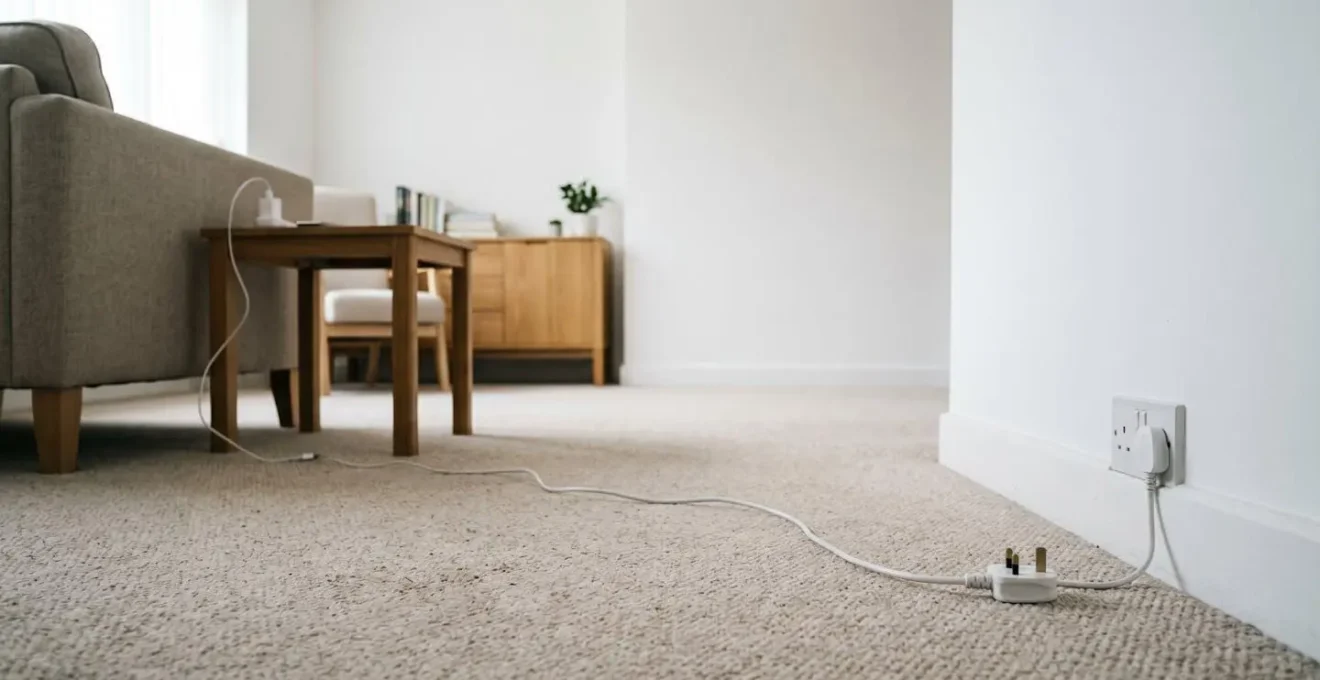
Managing these risks requires a shift in perspective from plugging holes to managing the entire environment. This means securing furniture that can be pulled over, ensuring blind cords are tied up and out of reach, and, crucially, controlling the electrical spaghetti that populates modern homes. An appliance like a kettle, with its cord dangling from a worktop, combines a burn risk, a fall risk (from pulling the appliance down), and an electrical risk into one common household item. Focusing on securing that one kettle cord provides a far greater safety return than plugging every socket in the house.
Why Your Beautiful Second-Hand Cot Might Fail Current British Safety Standards?
The socket protector myth is part of a larger issue in baby-proofing: the assumption that if something looks safe, it must be safe. This fallacy extends to many other areas, particularly with second-hand equipment like cots, highchairs, and car seats. A vintage cot may be aesthetically pleasing and have sentimental value, but it is highly likely to fail modern safety standards, posing a significant risk to your child.
British safety standards are not static; they evolve based on data from accidents and new research. For cots, current standard (BS EN 716) specifies critical details like the distance between bars (to prevent a baby’s head from getting trapped), the height of the sides, and the absence of cut-outs or ledges that could be used for climbing. An older cot, even from just a decade ago, might have bars that are too far apart, use lead-based paint, or have decorative features that create snagging or entrapment hazards. The beautiful « heirloom » piece could, in reality, be a safety nightmare.
This principle applies across the board. Just as we must trust the engineering of the BS 1363 socket standard over a non-standard plastic cover, we must trust current safety standards for nursery furniture over aesthetics or tradition. As RoSPA wisely notes, « Most home accidents are preventable through increased awareness, improvements in the home environment and greater product safety. » Relying on products that meet these contemporary, evidence-based standards is a cornerstone of creating a genuinely safe environment, rather than just one that feels safe.
How to Audit Each Room for Hazards Using a 50-Point Safety Checklist?
Moving from theory to practice is the most important step in creating a safer home. Instead of focusing on the non-issue of socket covers, a systematic audit of each room for genuine hazards will yield a much higher return on your safety investment. This means getting down to your child’s level—literally—and seeing the world from their perspective. What is within their reach? What can be pulled down? What can be swallowed?
A thorough audit goes beyond the obvious. It involves checking for looped cords on blinds (a major strangulation risk), ensuring heavy furniture is anchored to the wall, and verifying that cleaning products are locked away. In the electrical domain, it means inspecting every cable for damage, ensuring extension leads are not daisy-chained or overloaded, and keeping heat-producing appliances like hair straighteners well out of reach, even while cooling down. It’s about building consistent habits and creating an environment where safety is the default.
This process can feel overwhelming, which is why a structured checklist is so valuable. It helps you to be systematic and ensures that less obvious dangers are not forgotten. By focusing your time and energy on these verified risks, you are actively reducing the statistical probability of an accident in your home.
Your Practical Electrical Safety Audit: Key Points to Check
- Task: Remove and discard all plug-in socket protectors. Rationale: They are unnecessary for UK BS 1363 sockets and create choking and electrocution hazards.
- Check all phone and tablet chargers for damage or fraying, particularly near plug connections, and replace any that are not in perfect condition.
- Ensure hair straighteners are placed in a heat-proof bag immediately after use and stored high up or in a locked cupboard, completely out of a child’s reach.
- Verify that kettles, toasters, and other hot appliances are positioned at the very back of worktops, with their cords secured so they cannot be pulled by a child.
- Inspect all extension leads to ensure they are not overloaded and are never « daisy-chained » (plugged into one another).
Key takeaways
- UK BS 1363 sockets are inherently child-safe due to a mandatory shutter system; no additional cover is needed.
- Official bodies like the NHS and electrical safety experts actively advise against using socket protectors as they can damage sockets and override their safety features.
- The real electrical dangers in a home are trailing cables, faulty appliances, and overloaded extension leads, not empty sockets.
Why Babyproofing at 3 Months Prevents the A&E Visit at 7 Months?
One of the most common mistakes parents make is underestimating the speed of a baby’s development. A baby who is stationary at three months can be rolling at four, crawling at six, and pulling themselves up to stand at seven. This rapid progression means that a seemingly distant hazard can become an immediate danger overnight. Proactive baby-proofing is not about being paranoid; it’s about staying one step ahead of your child’s developing mobility and curiosity.
The statistics on childhood accidents are a stark reminder of this reality. According to data cited by the National Accident Helpline, more than two million children under the age of 15 are taken to A&E departments every year in the UK following an accident in the home. Many of these incidents are preventable and occur in the brief window after a child acquires a new skill but before the home environment has been adapted.
This is why the principle of « baby-proof early » is so critical. Addressing hazards like unsecured furniture, accessible cables, and low-level storage of dangerous goods should be done long before your child is mobile. By the time you see your baby starting to crawl, your home should already be a safe space for them to explore. This proactive mindset is the foundation of effective accident prevention. Indeed, as a RoSPA’s 2024 report reveals that accidents are the most common cause of preventable death in children under 15, reinforcing the urgent need for proactive safety measures rather than reactive panic.
Now that you are equipped with the facts, the next logical step is to perform a systematic audit of your own home. Remove and responsibly discard any socket protectors and redirect your focus to the genuine hazards identified in this guide. Your child’s safety depends not on a false sense of security from a piece of plastic, but on a clear-eyed assessment and management of real-world risks.