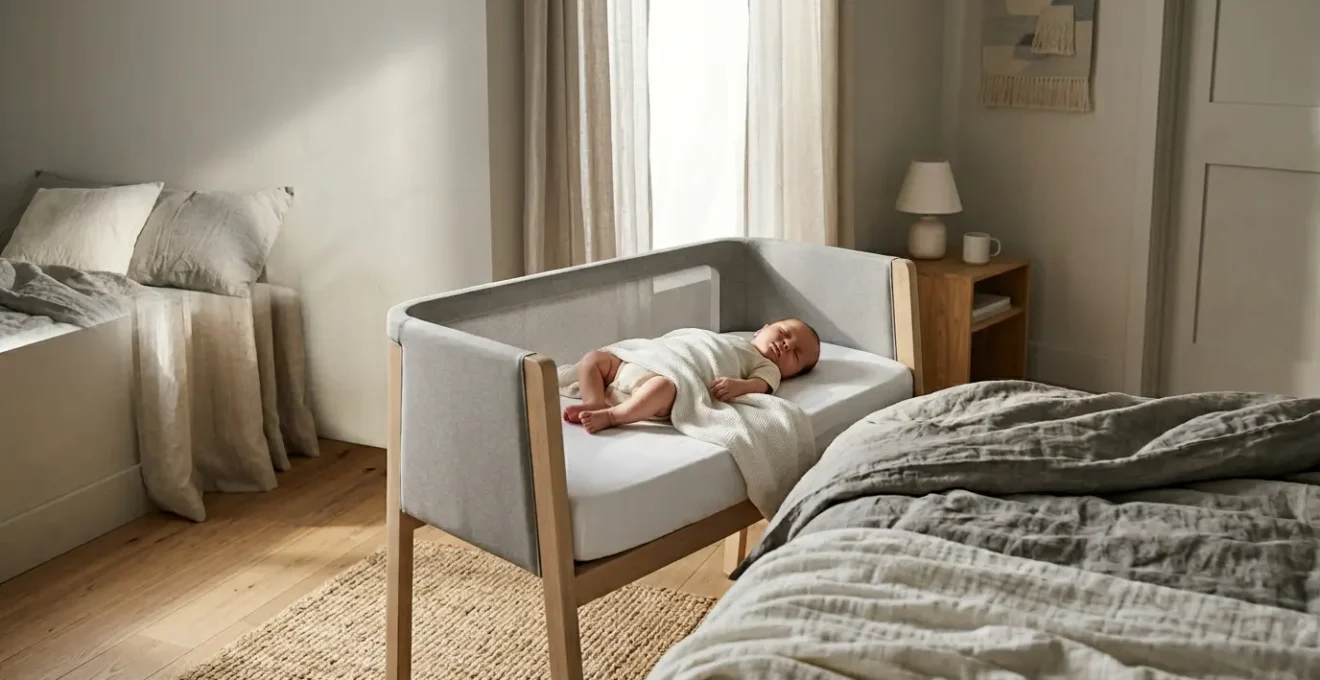
In summary:
- Your baby’s developmental milestones, like rolling, are the true indicator for transitioning to a cot, not their age or the manufacturer’s weight limit.
- A firm, flat mattress is non-negotiable to prevent rebreathing CO2, a major SIDS risk factor.
- The « feet-to-foot » position is a simple mechanical barrier that can significantly reduce suffocation risk from blankets.
- Room-sharing is safest when the bassinet is close but never touching adult bedding, and bedside sleepers must be securely anchored to prevent dangerous gaps.
The first few weeks with a newborn are a blur of emotions, nappy changes, and an overwhelming desire for sleep. For UK parents, one of the first major decisions is where your baby will sleep. The debate between a classic Moses basket and a modern bedside crib like a SnuzPod or Next2Me can feel monumental. You weigh up the aesthetics, the cost, the space in your bedroom, and the promise of a few more precious minutes of rest.
Most advice centres on these practicalities, followed by the universal, non-negotiable instruction to « follow safe sleep guidelines. » While organisations like The Lullaby Trust provide invaluable rules, parents are often left following them without fully understanding the critical reasons behind them. We’re told to use a firm mattress, keep the cot bare, and place the baby on their back, but the ‘why’ can get lost in the exhaustion.
This guide takes a different approach. Instead of just listing the rules, we will delve into the evidence-based science behind them. What if the key to true peace of mind wasn’t just following a checklist, but deeply understanding the physiological vulnerabilities of your newborn and the mechanical hazards of their sleep environment? This knowledge empowers you to make genuinely safe choices, not just for the first 8 weeks, but for every sleep until they’re in their own room.
We will explore the specific developmental triggers that make a bassinet unsafe, show you how to test your mattress firmness, and explain the science behind positioning. By understanding the ‘why’, you can navigate the marketing claims and create a truly safe haven for your baby.
Summary: A Parent’s Guide to Bassinet and Bedside Crib Safety
- Why Most Babies Outgrow the Bassinet by 4 Months Despite Manufacturer Claims?
- How to Test If Your Bassinet Mattress Is Firm Enough With a Simple 2-Second Check?
- Why Your Bassinet Should Be Arm’s Length Away but Never Touching Your Duvet?
- The Cosy Fleece Liner That Doubles Overheating Risk in Winter
- When Your Baby Starts Rolling in the Bassinet: The 48-Hour Transition Window
- Why Stomach Sleeping Triples SIDS Risk Even When Your Baby Seems to Prefer It?
- Why Keeping Your Baby in the Car Seat Carrier Indoors Weakens Their Neck?
- Why the « Feet to Foot » Position Reduces SIDS Risk by 50%?
Why Most Babies Outgrow the Bassinet by 4 Months Despite Manufacturer Claims?
One of the most confusing aspects of baby gear is the lifespan of a product. Bassinet manufacturers often state a weight limit (e.g., 20 pounds or 9 kg) or an age limit of « around 6 months. » However, from a safe sleep perspective, these numbers are largely irrelevant. The true expiry date on your bassinet is dictated by your baby’s developmental milestones, not their weight. The most critical milestone is rolling over.
Once a baby can push up or begin to roll, the shallow sides of a Moses basket or bassinet become a significant fall hazard. What’s more, a baby who rolls in a confined space may become wedged against the side, increasing the risk of suffocation. While the average transition age is around four months, some babies show signs of rolling much earlier. Pediatric safety guidelines highlight that the rolling milestone can occur as early as 2-3 months for some infants, making it crucial for parents to be vigilant.
Therefore, you must watch the baby, not the calendar or the scale. The moment you see your baby intentionally trying to roll from back to side or pushing up on their arms during tummy time, the transition out of the bassinet is imminent. Relying solely on the manufacturer’s guidelines can create a false sense of security, ignoring the unique and rapid development of your own child. The rule is simple: once they show signs of rolling, the bassinet is no longer a safe option for any sleep.
This « baby-led » approach to transitioning is the first step in creating a sleep environment that adapts to their growing abilities, not just their size.
How to Test If Your Bassinet Mattress Is Firm Enough With a Simple 2-Second Check?
The advice to use a « firm » mattress is perhaps the most well-known safe sleep rule, yet « firm » can feel subjective to a new parent. The reason for this rule is critically important: it directly relates to the risk of suffocation and Sudden Infant Death Syndrome (SIDS). A soft mattress or surface can conform to the shape of a baby’s head. If they roll onto their stomach, their face can press into the soft material, creating a small pocket of trapped air. When they exhale, this pocket fills with carbon dioxide; with each new breath, they rebreathe this CO2 instead of fresh oxygen. This is called rebreathing, and it can tragically suppress a baby’s natural arousal response to wake up and turn their head.
A truly firm mattress prevents this from happening. It doesn’t indent under the baby’s weight, ensuring their airway remains clear even if they turn their head. So, how can you be sure your mattress is firm enough? Forget the marketing terms and perform this simple 2-second check: Press your hand down firmly in the centre and at the edges of the mattress. When you lift your hand, the surface should snap back immediately, showing no indentation from your hand.

As this visual demonstrates, a safe surface resists pressure. If the mattress contours to your hand, it is too soft and poses a serious safety risk. This principle of a firm, flat surface is the cornerstone of a safe sleep environment, and it is entirely non-negotiable. Always use the mattress that was designed specifically for your bassinet model and never add any soft toppers, « nests, » or pillows.
Your Action Plan: Safe Sleep Surface Checklist
- Assess Sleep Products: Only use products specifically designed for sleep, such as cribs, bassinets, and play yards that meet current safety standards.
- Remember ‘Bare is Best’: Your baby’s sleep space should contain nothing but a fitted sheet. No bumpers, loose blankets, toys, or positioners.
- Check the Incline: Ensure the sleeping surface is flat and does not incline more than 10 degrees, as an incline can compromise the baby’s airway.
- Perform the Firmness Test: Verify the mattress is firm and does not indent when your baby is lying on it.
- Verify Safety Standards: For UK parents, look for products that comply with British Standards (BS EN 1130 for cribs and BS EN 1466 for Moses baskets).
Ultimately, a firm mattress is the foundation upon which all other safe sleep practices are built, actively protecting your baby’s ability to breathe freely.
Why Your Bassinet Should Be Arm’s Length Away but Never Touching Your Duvet?
Room-sharing—having your baby sleep in a separate cot or bassinet in the same room as you—is a cornerstone of safe sleep advice. It is not the same as bed-sharing or co-sleeping. The American Academy of Pediatrics (AAP) recommends room-sharing because it can decrease the risk of SIDS by as much as 50%. The theory is that the parent’s presence, including background noises and even their breathing, helps keep the baby in a lighter state of sleep, making them more easily arousable if they encounter breathing difficulties.
However, the positioning within the room is a game of millimeters. The bassinet should be close enough for you to easily check on, comfort, and feed your baby—often described as « arm’s length. » But « close » must not mean « touching. » The primary mechanical hazard here is your own adult bedding. A duvet, pillow, or heavy blanket that falls into the bassinet can obstruct your baby’s airway and lead to suffocation or overheating. Keeping a small but clear gap between your bed and the bassinet eliminates this risk.
This becomes even more critical with bedside sleepers, which are designed to sit flush against the adult bed. For these products, the risk shifts from falling bedding to entrapment. If a gap opens up between the sleeper’s mattress and your mattress, a baby can roll into it and become trapped, unable to breathe. This is why you must always use the provided anchor straps that run under your own mattress, pulling the sleeper tight against your bed to ensure there is absolutely no gap. This creates a single, continuous sleep surface and mitigates the entrapment hazard.
The goal is proximity for supervision and comfort, but separation for safety. It’s about finding that sweet spot of being close, but not dangerously so.
The Cosy Fleece Liner That Doubles Overheating Risk in Winter
During cold UK winters, a parent’s natural instinct is to bundle their baby up to keep them warm. This often leads to the use of cosy-looking additions like fleece sleepsuits, thick blankets, or plush bassinet liners. While well-intentioned, these items can be incredibly dangerous. Overheating is a significant risk factor for SIDS, and materials like polar fleece are a primary culprit. A 30-year Canadian study found that there was a 2.78 times greater chance of sudden infant death on very hot days, illustrating the powerful link between heat and SIDS.
The danger is rooted in your baby’s physiological vulnerability. Infants, especially in the first few months, are not good at regulating their own body temperature. They can’t sweat effectively to cool down, nor can they simply kick off a blanket if they get too hot. Furthermore, overheating can deepen a baby’s sleep, lowering their arousal threshold. This means if their breathing becomes obstructed, they are less likely to wake themselves up to correct the problem.
Synthetic materials like fleece are particularly problematic because they are not breathable. They trap heat and moisture against the baby’s skin. As one expert from The Sleep Store Australia vividly puts it:
Polar fleece is NOT appropriate for babies to wear or use for bedding, and it can certainly contribute to overheating. Imagine how hard is it for your baby to be a comfortable temperature if your baby was wrapped in gladwrap.
– The Sleep Store Australia, Avoiding Overheating with Your Baby
The safest way to keep your baby warm is by using layers of lightweight, breathable clothing and a baby sleeping bag of the appropriate tog rating for your room temperature—never with an additional blanket. Check for overheating by feeling the back of their neck or their chest; it should feel warm, not hot or sweaty. Their hands and feet will often feel cool, which is normal.
Resist the urge to add that « cosy » fleece layer; breathable layers provide all the warmth your baby needs without the risk.
When Your Baby Starts Rolling in the Bassinet: The 48-Hour Transition Window
We’ve established that the ability to roll is the absolute, non-negotiable end-point for bassinet use. But this isn’t a milestone that happens gradually over weeks; it can seem to appear overnight. This is why we refer to it as a « 48-hour transition window. » The moment you see your baby achieve that first intentional roll (from back to front, or even just consistently getting onto their side), the clock starts. The bassinet, which was safe yesterday, is now a hazard.
The primary dangers are falls and suffocation. The low walls of a bassinet are simply not high enough to contain a mobile infant who can push up and roll, creating a serious fall risk. Secondly, if a baby rolls over in the narrow confines of a bassinet, they can become trapped against the side or in a corner with their face pressed into the fabric, leading to suffocation. This risk is exponentially higher if the baby is still swaddled, as their arms are pinned, preventing them from pushing themselves up to clear their airway.
This is not a time to « wait and see. » It is a time for immediate action. If you haven’t already, you must stop swaddling immediately. The transition to a cot that meets current safety standards (a firm, flat mattress in a bare environment) needs to happen that same day or, at the absolute latest, the next. A full-sized cot provides a larger, safer space for a rolling baby. Once a baby can roll confidently from their back to their stomach and also from their stomach back to their back, it is safe to leave them in the sleeping position they choose, provided you always place them on their back at the start of sleep.
It’s a clear developmental signal that your baby is ready for the next stage, and your job is to ensure their sleep environment is ready too.
Why Stomach Sleeping Triples SIDS Risk Even When Your Baby Seems to Prefer It?
The « Back to Sleep » campaign is one of the most successful public health initiatives in history, dramatically reducing the rate of SIDS. Yet, many parents will observe that their baby seems fussier on their back and settles more easily on their stomach. It’s tempting to let them sleep in the position they seem to prefer, but the evidence against it is overwhelming. The core reason lies in a combination of airway mechanics and the risk of rebreathing CO2.
When a baby lies on their back, their trachea (windpipe) is positioned on top of their oesophagus (food pipe). This means any spit-up or reflux is more likely to be swallowed back down into the stomach, rather than being inhaled into the lungs. It’s a clever bit of natural safety engineering. But the biggest danger of stomach sleeping is rebreathing. As discussed earlier, if a baby sleeps face-down on a mattress, even a firm one, they can create a small pocket of air around their nose and mouth. They end up rebreathing their own exhaled air, which is low in oxygen and high in carbon dioxide. Research shows that compared with back sleeping, stomach sleeping increases the risk of SIDS by 1.7 to 12.9 times.

This intake of « stale » air can suppress their infant arousal response—the life-saving instinct to wake up and turn their head when they aren’t getting enough oxygen. Babies who die of SIDS are thought to have a vulnerability in this arousal mechanism, and stomach sleeping is a major trigger that exploits this vulnerability. While it might seem your baby is more « comfortable » on their stomach, they are often in a deeper, less easily-arousable state of sleep, which is precisely what makes it so dangerous. You must always place your baby on their back for every sleep, nap time and night time, without exception.
Their perceived comfort can never outweigh this scientifically-proven risk. A safe sleep position is always more important than a preferred one.
Why Keeping Your Baby in the Car Seat Carrier Indoors Weakens Their Neck?
It’s a scene familiar to every new parent: you finally get the baby to sleep in the car seat on the way home, and the last thing you want to do is wake them by moving them. So, you bring the carrier inside and let them finish their nap. While convenient, allowing a baby to sleep in a car seat for extended periods outside of the car is dangerous for two key reasons: positional asphyxia and developmental delay.
A car seat is designed to protect a baby during a crash. Its semi-reclined, bucket-like shape is not designed for safe sleep. This ‘C’ shape can cause a baby’s head, which is disproportionately heavy, to slump forward, pushing their chin down onto their chest. This position can partially or fully block their tiny, flexible airway, leading to a silent and gradual reduction in oxygen, known as positional asphyxia. The danger is compounded because the incline is often subtle. However, rigorous Consumer Reports testing confirms that an incline greater than 10 degrees is dangerous to a baby’s airflow and violates federal safe sleep standards for bassinets.
Beyond the immediate suffocation risk, habitual napping in a carrier has a developmental cost. The snug, contained shape of the car seat prevents the baby from moving freely. As pediatric safety experts note, this prevents them from using and strengthening the crucial neck, back, and core muscles. These are the very muscles needed to achieve milestones like good head control, which is in itself a protective factor, allowing them to move their head to clear their airway. A flat, firm surface encourages this movement and muscle development; a car seat actively restricts it.
The rule is clear: if the journey is over, the baby should be moved to their cot or bassinet, even if it means waking them. A few minutes of crying is infinitely better than the risks associated with sleeping in a carrier.
Key Takeaways
- Milestones Over Age: Your baby’s developmental stage, especially rolling, is the only true indicator for when a bassinet is no longer safe.
- Firm, Flat & Bare: The safest sleep surface is non-negotiable. It must be firm, completely flat, and have nothing in it but a fitted sheet.
- Position is Protection: Always place your baby on their back to sleep, and use the ‘feet-to-foot’ position to prevent them from wriggling under blankets.
Why the « Feet to Foot » Position Reduces SIDS Risk by 50%?
Alongside « Back to Sleep, » the « Feet to Foot » position is a simple yet powerful piece of safe sleep advice, particularly emphasised by UK charities like The Lullaby Trust and Tommy’s. It’s a straightforward instruction: when you put your baby down in their cot or Moses basket, you place their feet at the very bottom (the foot) of the sleep space. Any blankets should then be tucked in securely under the mattress and come up no higher than their shoulders. But why is this simple piece of choreography so effective?
The reasoning is purely mechanical and designed to prevent a major cause of SIDS: head covering. UK safe sleep guidelines emphasize that babies whose heads become covered with bedding are at a significantly increased risk of suffocation and overheating. A baby placed in the middle of a cot has room to wriggle down underneath their blankets during the night. The « feet-to-foot » position acts as a physical barrier. With their feet already at the end, they simply cannot slide down any further, making it impossible for them to become fully submerged under the covers.
The impact of this simple practice has been profound, and its adoption in the UK provides a powerful real-world example of its effectiveness.
UK Case Study: The Impact of « Feet to Foot » on SIDS Rates
A review of major UK SIDS case-control studies conducted ten years apart revealed a direct correlation between the rise of the « feet-to-foot » practice and a fall in SIDS rates. Researchers noted that the steep falls in accidental head covering by bedding ran parallel to the increased parental use of this positioning. The study, published by the NCBI, attributes a significant portion of the halving of the SIDS rate during this period to the adoption of preventative practices like « feet-to-foot, » which creates a simple but effective mechanical barrier preventing babies from sliding under blankets.
This technique is a perfect illustration of how a small, deliberate action can eliminate a major environmental hazard from your baby’s sleep space. It works in harmony with the « bare is best » principle; while a correctly used and securely tucked-in cellular blanket is considered safe, a well-fitting baby sleeping bag is an even simpler and often safer alternative that eliminates the risk of head covering entirely.
To apply this knowledge confidently, start by performing the 2-second mattress check on your current or prospective bassinet today. This single action is the most important first step you can take to ensure your baby has a safer place to sleep.