
The feeling of a ‘broken’ pelvic floor after a C-section often has less to do with the surgery itself and more to do with the nine months of physiological load from pregnancy.
- Pregnancy stretches and strains abdominal and pelvic connective tissues, regardless of delivery method.
- Your recovery is a unique trajectory, not a linear race to a 6-week finish line.
- Understanding specific red flags is far more empowering than simply waiting for your GP check-up.
Recommendation: Shift your focus from a delivery-centric view to a whole-body, pregnancy-led recovery, and consider a specialist assessment with a women’s health physiotherapist for a truly personalised plan.
You’ve made it to the six-week mark. It’s the milestone everyone talks about, the point where you’re supposed to get the « all clear » from your GP and start feeling like yourself again. Yet, as you sit here, something feels off. You might have been told that a Caesarean section would « spare » your pelvic floor, but you’re experiencing heaviness, leaking, or just a profound sense of disconnection from your core. It’s a confusing and often isolating feeling. You’re trying to « listen to your body, » but what are you supposed to be listening for?
The common postpartum narrative often focuses on the C-section scar itself—is it healing cleanly? But this hyper-focus can mean we miss the bigger picture. The truth is, your body has just completed the marathon of pregnancy. For nine months, it underwent immense changes to support a growing baby, and those changes don’t magically vanish the moment you give birth. The « physiological load » of pregnancy is the real story here, placing sustained stress on your abdominal wall, back, and pelvic floor.
But what if the key to your recovery isn’t just about healing from surgery, but about understanding and responding to the after-effects of pregnancy itself? This perspective shifts everything. It explains why your pelvic floor can feel weak even without a vaginal delivery and why your pre-pregnancy clothes still feel alien. It’s not that you’re « broken » or your recovery is failing; it’s that your body is on a complex healing journey that deserves to be understood.
As a women’s health physiotherapist, I want to pull back the curtain on what’s really happening inside your body. This guide will decode the confusing symptoms you might be experiencing, explain the ‘why’ behind them within the context of the UK healthcare system, and empower you to become an active advocate for your own healing. We’ll explore everything from sudden bleeding and diastasis recti to knowing when you can safely return to exercise, giving you the clarity and confidence you deserve.
This article will provide a clear, expert-led breakdown of the most common postpartum concerns. Use the summary below to navigate to the questions that matter most to you right now, and let’s begin the process of understanding your postpartum body, together.
Summary: A Physio’s Guide to Your Postpartum Body
- Why Your Bleeding Suddenly Increases on Day 10 and When to Call the Midwife?
- How to Check for Diastasis Recti at Home Before Starting Any Exercise?
- Vaginal Birth vs C-Section Recovery: Which Activities Can You Resume at Week 4?
- The 3 Postpartum Infection Signs That A&E Sees Too Late Every Week
- When Can You Safely Start Running Again After a Third-Degree Tear?
- Why Your Belly Stays Pregnant-Looking for Weeks After Delivery?
- Peri Bottle vs Sitz Bath vs Witch Hazel Pads: Which Actually Soothes Stitches?
- Why Your Pre-Pregnancy Joggers Will Not Fit for 6 Weeks After Birth?
Why Your Bleeding Suddenly Increases on Day 10 and When to Call the Midwife?
Postpartum bleeding, known as lochia, is a normal and expected part of recovery. It typically starts as a heavy, bright red flow and gradually tapers, changing to pink or brown, and finally to a yellowish-white discharge over several weeks. However, many women experience a sudden, alarming increase in bright red bleeding around day 10 to 14. This is often not a sign of a problem, but rather the « placental scab » detaching from the uterine wall as it heals. It’s a normal physiological process, but the sudden gush can be frightening if you’re not expecting it.
The key is to differentiate this normal event from something more serious, like a secondary postpartum haemorrhage (PPH). While relatively rare, affecting around 2 in 100 postnatal women in the UK, it requires immediate medical attention. The distinction lies in the volume, accompanying symptoms, and duration. A temporary increase from the placental site healing should settle within a few hours. A haemorrhage will not.
Your midwife, health visitor, or GP are there to support you. Never hesitate to call them if you are concerned. It is always better to be checked and reassured than to worry at home. To help you assess the situation, here are the key red flags to watch for:
- Pad Saturation: Soaking through a large maternity pad in less than an hour is a sign you need to seek immediate help. Call 999 or go to A&E.
- Large Clots: Passing blood clots larger than a £2 coin should prompt an urgent call to your midwife or NHS 111 for advice.
- Offensive Smell: If your lochia develops a foul, offensive smell, it can be a sign of a uterine infection. Contact your GP or midwife urgently.
- Feeling Unwell: If the increased bleeding is accompanied by dizziness, a racing heart, fever, or feeling generally unwell, this is an emergency.
Trust your instincts. The postpartum period is a time of significant change, and no question is too small or silly. If the bleeding pattern feels wrong to you, make the call.
How to Check for Diastasis Recti at Home Before Starting Any Exercise?
Diastasis Recti (also known as ‘mummy tummy’ or abdominal separation) is the widening of the connective tissue (the linea alba) that runs between your ‘six-pack’ muscles. It’s an incredibly common and normal adaptation during pregnancy to make space for your growing baby. It is not a tearing of the muscles, but a stretching of the tissue between them. This condition is very prevalent, with some research indicating that 39% of women still have a significant diastasis at six months postpartum.
Knowing if you have a separation is important before you return to exercise, as certain movements (like crunches, planks, or heavy lifting) can put undue pressure on this delicate tissue and potentially worsen the gap. Performing a gentle self-check at home can give you valuable information to guide your recovery. It’s best to wait until you are at least 3-4 weeks postpartum to allow for some initial natural healing.
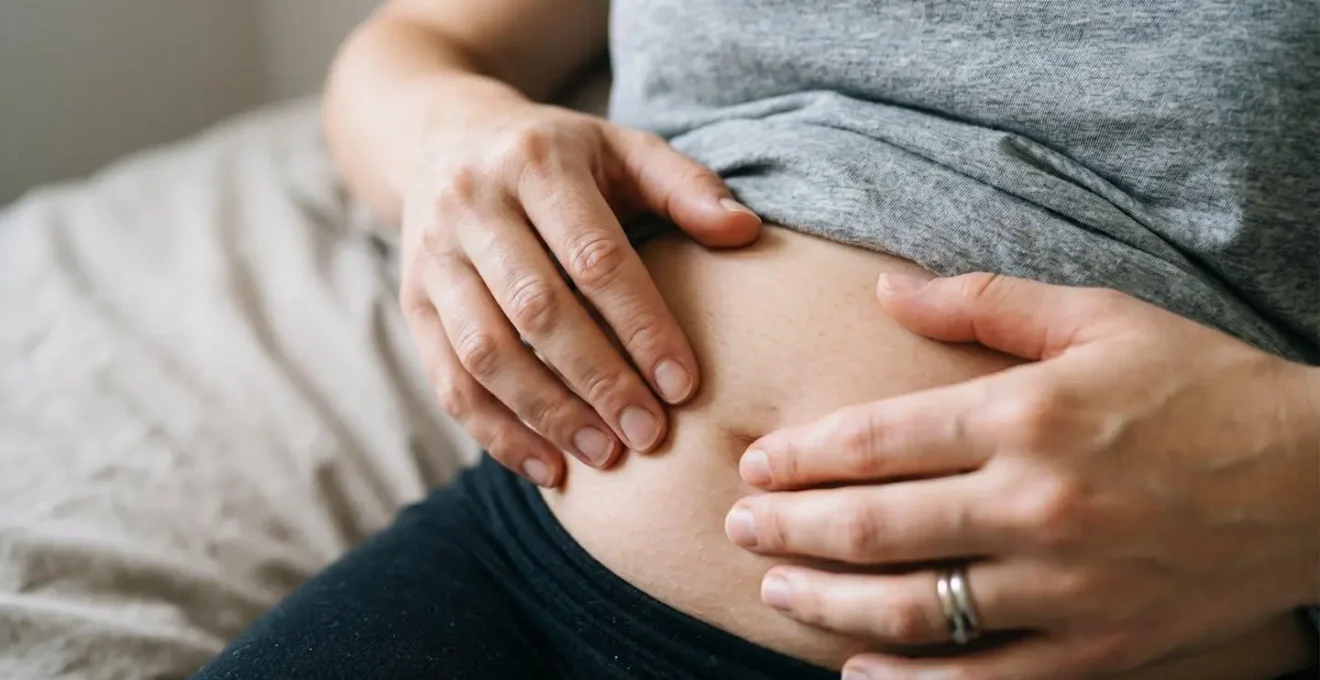
Here’s how to perform the check as shown in the image above:
- Lie on your back with your knees bent and feet flat on the floor.
- Place the fingertips of one hand on your midline at your belly button, with your fingers pointing towards your pelvis.
- Gently press down and slowly lift your head and shoulders off the floor, just enough to feel your abdominal muscles engage. Don’t do a full sit-up.
- You are feeling for two things: the width of the gap (how many fingers you can fit between the muscle walls) and the tension of the connective tissue underneath (does it feel firm like a trampoline or soft and deep?).
- Repeat this check a few inches above and below your belly button, as the gap can vary in width.
As a leading authority on medical information confirms, managing this condition effectively is key. The National Center for Biotechnology Information states:
While the optimal treatment of diastasis recti has not been determined, most sources recommend conservative management with lifestyle modifications, weight loss, and physiotherapy as the first-line treatment for bothersome diastasis recti.
– National Center for Biotechnology Information, Diastasis Recti Rehabilitation – StatPearls
Regardless of what you find, this self-check is a screening tool, not a diagnosis. The gold standard is an assessment with a women’s health physiotherapist who can evaluate your whole core system and provide a safe, effective exercise programme tailored to you.
Vaginal Birth vs C-Section Recovery: Which Activities Can You Resume at Week 4?
At four weeks postpartum, you’re likely feeling a bit more human and eager to reclaim some sense of normalcy. However, what you can safely do depends heavily on your delivery type. A C-section is major abdominal surgery, involving multiple layers of tissue that need to heal, while an uncomplicated vaginal birth involves recovery of the perineum and pelvic floor. Neither is « easier, » they are just different healing journeys.
For C-section recovery, the primary limitation is the integrity of your abdominal wound. Lifting anything heavier than your baby is generally advised against to avoid straining the incision. Driving is also a key consideration; you must be able to perform an emergency stop without pain or hesitation and should check with your car insurance provider for their specific policy. For a vaginal birth, the focus is more on pelvic floor and perineal comfort. While you might feel able to do more, it’s crucial not to overdo it and compromise healing tissues.
The following table provides a general guide for what activities are typically appropriate at the four-week mark. This is not medical advice, but a framework to help you make sensible decisions. Remember, « listen to your body » means paying attention to any increase in pain, bleeding, or feelings of pelvic pressure, which are signals to scale back.
| Activity | C-Section (Week 4) | Vaginal Birth (Week 4) |
|---|---|---|
| Walking | Short to moderate walks encouraged | Moderate to longer walks typically comfortable |
| Lifting | Maximum 10-15 pounds (nothing heavier than baby) | Gradual increase, listen to body |
| Driving | Check with insurer; perform emergency stop test if comfortable | Usually cleared if comfortable and not on pain medication |
| Light housework | Light tasks OK, avoid vacuuming | Most light housework comfortable |
| Pelvic floor exercises | Start gentle exercises regularly | Continue regular pelvic floor activations |
| High-impact exercise | Not recommended until 12 weeks minimum | Not recommended until assessed by physiotherapist |
This timeline aligns with general advice from healthcare providers. For instance, Mount Sinai Hospital notes that after a C-section, « You should be able to do most of your regular activities in 4 to 8 weeks. » This highlights that week 4 is still very much in the early phase of recovery.
The most important activity you can do at four weeks is gentle movement like walking, and consistent, gentle pelvic floor activations. Pushing yourself too hard now can set your recovery back for months. Be patient and kind to your healing body.
The 3 Postpartum Infection Signs That A&E Sees Too Late Every Week
While the vast majority of women recover without issue, postpartum infections are a serious complication that healthcare professionals want you to be aware of. They are more common than many people think, affecting between 5% to 7% of postpartum patients. The danger with these infections is that they often develop after you’ve been discharged from the hospital, leaving you as the first line of defence in spotting the warning signs.
In fact, the data is stark: one review showed that 94% of postpartum infection cases were diagnosed after discharge from the hospital, which underscores why patient education is so critical. As a new mother, you are exhausted, overwhelmed, and may dismiss early symptoms as a « normal » part of recovery. However, delaying treatment can lead to much more serious complications like sepsis. Trusting your gut instinct is vital; if you feel something is truly wrong, it probably is.

In the A&E department, we too often see women who have waited too long to seek help. To protect yourself, memorise these three cardinal signs of postpartum infection. If you experience any of them, you must contact your GP, midwife, or NHS 111 for an urgent assessment.
- A Persistent Fever or Chills: A temperature of 38°C or higher, especially if accompanied by flu-like symptoms, body aches, or chills, is a major red flag. Don’t just dismiss it as being « run down. » Check your temperature and make the call.
- Foul-Smelling Vaginal Discharge (Lochia): Your lochia will have a metallic, earthy smell, but it should not be foul or offensive. A smell often described as « fishy » or like « bad meat » is a classic sign of a uterine infection (endometritis) and requires immediate medical attention.
- Severe, Localised Pain, Redness, or Pus: Pay close attention to your C-section incision or your perineum if you had a tear or episiotomy. Increasing pain, spreading redness, hardness, warmth to the touch, or any pus-like discharge from a wound is a clear sign of infection.
You are your own best advocate. In the blur of new motherhood, it’s easy to put your own health last. Please don’t. If you feel unwell or spot any of these signs, seek help immediately. It’s the most important thing you can do for yourself and your new baby.
When Can You Safely Start Running Again After a Third-Degree Tear?
For many women, running is more than just exercise; it’s a source of mental clarity and freedom. The desire to lace up your trainers and hit the pavement postpartum is completely understandable. However, after a significant perineal tear (classified as a third or fourth-degree tear), returning to high-impact exercise like running requires a cautious, considered, and specialist-guided approach. These tears involve injury to the anal sphincter muscles, and returning to running too soon can risk long-term incontinence and pelvic organ prolapse.
The absolute minimum timeframe before even considering a return to running is 12 weeks (3 months) postpartum. This is non-negotiable. It allows time for significant tissue healing and for the supportive ligaments, which were loosened by pregnancy hormones, to regain some of their strength. In the UK, if you’ve had a 3rd or 4th-degree tear, you should be invited to a specialist perineal clinic for a follow-up appointment. This is a critical opportunity to discuss your recovery and your return-to-sport goals with an expert.
Before you even think about your first jog, you need to ensure your pelvic floor has regained sufficient strength and control. As The Royal Women’s Hospital in Melbourne advises in their guidelines, you can perform a simple self-screen:
Before attempting high impact exercises you should check your pelvic floor strength by coughing with a full bladder or jumping with a full bladder. You are ready for more high impact exercise if there is no urine leakage.
– The Royal Women’s Hospital Melbourne, Exercise after birth guidelines
If you experience any leakage during this test, you are not ready. It’s a clear signal that your pelvic floor needs more time and targeted strengthening. Leakage during running is never normal and is a sign to stop and seek help from a women’s health physiotherapist. To guide your journey, follow this essential checklist.
Your action plan for returning to running after a severe tear
- Wait a minimum of 3 months postpartum before attempting any high-impact exercise like running.
- Perform a pelvic floor self-test: cough or jump with a relatively full bladder. If there’s no urine leakage, you may be ready to progress.
- Attend your perineal clinic follow-up appointment (mandatory for 3rd/4th degree tears) and ask specific questions about returning to sport.
- If leakage occurs at 3+ months postpartum, seek an assessment from a women’s health physiotherapist or your GP before progressing.
- Start with a graduated return-to-running programme (like Couch to 5K) only after passing strength and control tests.
- Remember that leakage during running is NOT normal and indicates the need to stop and seek specialist pelvic floor help.
Patience is your greatest asset here. Giving your body the time and specific rehabilitation it needs now will pay dividends for years to come, ensuring you can run safely and confidently for the long haul.
Why Your Belly Stays Pregnant-Looking for Weeks After Delivery?
One of the most common and emotionally challenging postpartum experiences is looking in the mirror weeks after birth and still seeing a pregnant-looking belly. Whether you had a vaginal birth or a C-section, this is an almost universal phenomenon. As the Mayo Clinic plainly states in its C-section recovery guide, « It’s common to still look pregnant after a C-section. » It’s a reality that is seldom discussed, leading many new mothers to feel insecure or that their body has failed them. But there are clear physiological reasons for this.
Firstly, your uterus has just spent nine months expanding to the size of a watermelon. It doesn’t shrink back overnight. This process, called involution, takes time. Immediately after birth, your uterus is still firm and sits around the level of your belly button. It takes approximately six weeks for it to shrink back to its pre-pregnancy size and tuck down behind your pubic bone. This alone accounts for a significant amount of the « pooch. »
Secondly, there’s the matter of Diastasis Recti, which we discussed earlier. The stretched connective tissue in your abdomen means there is less tension across your midline to hold everything in. Your internal organs and abdominal contents can pooch forward through this weakened area, contributing to the pregnant look. This is a functional issue, not a weight issue.
Finally, your body is still dealing with leftover fluid, swelling, and shifted fat stores from pregnancy. Healing from birth, especially a C-section, involves a significant inflammatory response which leads to fluid retention. It can take many weeks for your body to rebalance its fluid levels and for this swelling to subside. All these factors combined create the postpartum belly. It is a sign of what your body has accomplished, not a sign of failure.
Your body has done something incredible. The focus should not be on « bouncing back » but on gentle healing, proper nutrition, and starting a safe core restoration programme with a professional when you are ready. The belly will change, but it will do so on its own timeline.
Peri Bottle vs Sitz Bath vs Witch Hazel Pads: Which Actually Soothes Stitches?
If you’ve had a vaginal birth with a tear or episiotomy, managing perineal pain and keeping your stitches clean can feel like a full-time job. The market is full of products promising relief, but knowing which one to use and when can be confusing. A peri bottle, a sitz bath, and witch hazel pads all serve different, complementary purposes in your healing toolkit. Understanding their specific benefits is key to using them effectively.
The peri bottle is your non-negotiable essential for hygiene. It’s a simple squirt bottle you fill with warm water and use to rinse your perineum after using the toilet. Wiping with toilet paper can be abrasive and painful on stitches, and it risks introducing bacteria. The peri bottle gently cleanses the area without friction, reducing the risk of infection and providing a moment of soothing relief. You should use it every single time you go to the bathroom for the first few weeks.
A sitz bath is primarily for soothing and promoting healing. This is a small basin that fits over your toilet, which you fill with warm water (not hot) to soak your perineum for 10-15 minutes. The warm water increases blood flow to the area, which can aid healing and relax tense muscles. It’s particularly effective for relieving discomfort from haemorrhoids and general swelling. On the other hand, witch hazel pads (or ‘Tucks’) and ice packs offer cooling, anti-inflammatory relief. Witch hazel is a natural astringent that can help reduce swelling and soothe irritation. You can place the pads directly on your maternity towel for constant, cooling comfort.
The following table breaks down the primary role of each method to help you build your care routine. A crucial safety note for all postpartum women comes from the Cleveland Clinic: « Don’t use tampons or insert anything into your vagina for at least six weeks. » This is to prevent introducing bacteria and causing a serious infection.
| Method | Primary Benefit | Best Used For | When to Use |
|---|---|---|---|
| Peri Bottle | Gentle cleansing without friction | Post-toilet hygiene, perineal tears | Every bathroom visit for first 6 weeks |
| Sitz Bath | Warm water soothing and circulation boost | Hemorrhoids, swelling, perineal discomfort | 2-3 times daily for 10-15 minutes |
| Witch Hazel Pads | Cooling anti-inflammatory relief | Hemorrhoids, surface irritation | As needed, can be chilled for extra relief |
| Ice Packs | Immediate swelling and pain reduction | First 24-48 hours post-delivery | 20 minutes on, 20 minutes off cycles |
| Sanitary Pads Only | Infection prevention (no tampons) | Managing lochia safely | Throughout 6-week recovery period |
Ultimately, a combination approach is often best. Use the peri bottle for cleanliness, a sitz bath for deep soothing, and witch hazel pads or ice packs for immediate, cooling relief from swelling. This multi-pronged strategy will keep you comfortable and support your body’s natural healing process.
Key takeaways
- Pregnancy’s physiological load, not just the birth method, is the primary driver of many postpartum symptoms like pelvic floor weakness and abdominal separation.
- The 6-week check-up is an important milestone, but it is not a finish line. True recovery is an individual trajectory that can take many months.
- Pelvic floor symptoms like leaking or heaviness after a C-section are common, not a sign of failure, and are highly treatable with specialist help.
Why Your Pre-Pregnancy Joggers Will Not Fit for 6 Weeks After Birth?
It’s one of the more surprising and sometimes frustrating realities of the postpartum period: you’ve lost some of the baby weight, your belly is slowly shrinking, but your favourite pre-pregnancy joggers or jeans simply will not do up. You may find they don’t even go past your hips. This isn’t just about your tummy; it’s because pregnancy changes your body’s entire structure, including your skeleton.
The hormone relaxin, which is crucial for loosening the ligaments in your pelvis to prepare for birth, doesn’t just target one area. It circulates throughout your entire body, affecting all of your connective tissues. This leads to changes that have nothing to do with weight or muscle. As your baby grew, your rib cage had to physically expand and flare outwards to make room for your upwardly-displaced organs. This is a skeletal change, not a soft tissue one.
Case Study: Postpartum Body Changes Beyond Weight
During pregnancy, the entire rib cage expands to accommodate the growing uterus and shifted organs, not just the abdomen. This skeletal expansion, driven by the hormone relaxin which affects connective tissue throughout the body, can take several months to reverse. The rib cage may remain flared, explaining why even tops and bras continue to feel tight postpartum. Additionally, relaxin causes permanent changes in some women, including feet that become wider or longer, which is why pre-pregnancy shoes may no longer fit comfortably. These changes are independent of belly size or weight loss.
This explains so much. It’s why your bra feels tight, even if your breasts aren’t full of milk. It’s why your favourite top feels restrictive across your back. And it’s why your trousers won’t button, even if your stomach feels flatter. Your hips may also be wider, and for some women, this change can be permanent. It’s also incredibly common for your feet to go up half a or a full shoe size due to the ligaments in your arches loosening and your foot structure spreading.
So, put away those pre-pregnancy jeans for a few more months without guilt. Invest in comfortable, soft, high-waisted leggings or joggers that support your healing body. Your body has not failed; it has simply adapted to do an extraordinary job. The best next step is to embrace this new, strong body and seek out a postnatal check with a women’s health physiotherapist who can provide a full-body assessment and guide you on your personal recovery journey.