Growth & development
Watching your baby grow transforms every ordinary day into a milestone worth celebrating. Yet beneath those adorable first smiles and wobbly attempts at crawling lies an extraordinarily complex process. Your baby’s development isn’t simply about ticking boxes on a checklist—it’s an intricate, interconnected journey where physical strength enables exploration, exploration builds cognitive connections, and every interaction shapes their understanding of emotions and relationships.
Understanding how babies develop empowers you to support their growth naturally, recognise what’s typical, and know when to seek guidance. This comprehensive look at infant development covers the fundamental domains that shape your baby’s first years: from the physical foundations of head control and movement, through the sensory experiences that wire their brain, to the cognitive leaps and emotional bonds that define their emerging personality.
Rather than fixating on exact dates when skills should appear, you’ll discover why the sequence matters more than speed, how everyday moments become powerful learning opportunities, and when variation reflects healthy individuality versus a genuine concern requiring professional assessment.
The Foundation: Why Head Control Comes Before Everything Else
Every milestone your baby will achieve—sitting independently, reaching for toys, even babbling at you—relies on a single foundational skill: head and neck control. Newborns arrive with relatively weak neck muscles and a head that represents roughly a quarter of their body weight. This disproportionate ratio means their first developmental task involves building the strength to support and control that weight.
Head control develops gradually over the first four months. Initially, your baby can only lift their head briefly during tummy time, perhaps turning it from side to side while lying on their back. By eight weeks, you’ll notice more sustained head lifts. By four months, most babies achieve steady head control when held upright and can prop themselves on their forearms during tummy time, head raised confidently to survey their surroundings.
This progression isn’t arbitrary. Stable head control allows your baby to visually track objects, which builds eye-muscle coordination. It enables them to engage socially by maintaining eye contact during interactions. It provides the upper-body stability required for reaching and eventually sitting. When head control lags significantly—for instance, a four-month-old who cannot hold their head steady when supported upright—it can signal an issue requiring assessment, precisely because so many subsequent skills depend on this foundation.
You can support neck strength development through varied holding positions: upright against your shoulder, cradled in your arms, or lying face-down across your lap. Moving a high-contrast toy slowly across your baby’s field of vision during floor time encourages them to turn and lift their head, building strength through purposeful movement rather than passive positioning.
Motor Milestones: Understanding the Developmental Sequence
Physical development follows a predictable sequence, though the timing varies considerably between individual babies. Understanding this sequence helps you distinguish between normal variation and developmental patterns that warrant concern.
The Rolling-Sitting-Crawling-Walking Progression
Your baby’s gross motor skills emerge in a specific order dictated by neuromuscular maturation and physics. Rolling typically appears first (around 4-6 months), because it requires the least complex coordination and muscle control. This skill strengthens the core muscles and provides your baby’s first taste of self-directed movement.
Sitting comes next (6-8 months), demanding greater core strength and balance. Initially, babies sit with hand support, creating a tripod. As trunk muscles strengthen, they sit independently, freeing their hands for play—a development that dramatically expands their learning opportunities.
Crawling emerges once babies can support their weight on hands and knees whilst coordinating opposite limbs (typically 7-10 months). Some babies skip traditional crawling entirely, preferring bottom-shuffling or commando-crawling, which are equally valid developmental pathways.
Walking represents the culmination of this progression (typically 9-18 months, though the range is genuinely wide). The common myth that babies « should » walk by 12 months creates unnecessary anxiety. Some perfectly typical babies walk at 10 months; others wait until 16 or 17 months. What matters is steady progression through earlier milestones and appropriate muscle tone when assessed by a health professional.
Why Container Time Matters
Spending excessive time in equipment that restricts movement—car seat carriers, bouncers, swings, and walkers—can weaken your baby’s developing muscles. While these items serve legitimate purposes, using them for more than 4 hours daily limits the floor time babies need to build strength through natural movement.
Traditional baby walkers that suspend babies in a seat with their toes touching the ground are particularly problematic. They allow movement without requiring the core strength, balance, and weight-bearing that genuine walking demands, potentially delaying independent walking whilst creating safety hazards. Push-walkers that babies propel whilst standing offer better developmental support once they’re already pulling to stand independently.
Fine Motor Development: From Fist to Fingertips
While gross motor milestones capture our attention, your baby’s hand skills follow an equally fascinating progression that directly impacts their independence and learning capacity.
Newborns possess a powerful palmar reflex—they’ll grip your finger with surprising strength, but this is involuntary. Around 2-3 weeks, they begin discovering their hands exist, watching them wave across their vision. By 3-4 months, the reflex releases, replaced by intentional grasping using the whole palm (palmer grasp).
The raking grasp appears around 6-8 months, allowing babies to drag objects into their palm using all fingers. This evolves into the superior pincer grasp (9-12 months), where thumb and forefinger work in opposition to pick up tiny objects with precision. This milestone revolutionises self-feeding and fine manipulation.
You can support this progression by offering age-appropriate objects: soft rattles for early palmer grasping, varied textures for exploratory mouthing, and small safe foods like cooked peas or soft finger foods for pincer practice. Cheerios have become the unofficial training tool for thumb-forefinger coordination precisely because they’re safe, motivating, and perfectly sized.
Concerns arise when expected progressions stall—for example, a 9-month-old who cannot transfer toys between hands, or a 12-month-old still using only a fisted palmer grasp for all objects. These patterns may indicate difficulties with motor planning or muscle tone that benefit from early intervention.
Sensory Development: Building Your Baby’s Perception of the World
Every texture your baby touches, sound they hear, and visual pattern they observe creates neural pathways. Early sensory experiences literally shape brain architecture, making sensory development foundational to all learning.
Vision: From Blur to Clarity
Newborns see clearly only within 20-30cm—conveniently, the distance to your face during feeding. Their immature visual system cannot yet process subtle colours; they perceive high contrast best, which explains why black-and-white patterns captivate them.
Around 6-8 weeks, colour perception develops, and babies begin tracking moving objects smoothly. By 3-4 months, their vision sharpens considerably, depth perception emerges, and they demonstrate clear visual preferences. High-contrast cards and toys serve genuine developmental purposes in early weeks but should transition to colourful, three-dimensional objects as vision matures.
Creating a Sensory-Rich Environment
Your baby doesn’t need expensive sensory equipment. Transforming your living space into a learning environment involves offering varied experiences:
- Different textures to touch (soft blankets, crinkly paper, smooth wooden toys, bumpy rubber)
- Varied sounds (gentle music, household noises, nature sounds, your voice in different tones)
- Safe items to mouth and explore (which is how babies under 12 months primarily investigate objects)
- Visual variety through patterns, colours, and movement
However, balance matters. Some babies demonstrate sensory sensitivities—extreme reactions to tags in clothing, specific sounds, or certain textures. This may indicate differences in sensory processing. Equally, over-protecting babies from normal household noise and varied textures can limit their developing tolerance. Learning to read your individual baby’s responses helps you calibrate stimulation appropriately, offering sensory breaks when they become overwhelmed whilst gently expanding their comfort zone.
Cognitive Leaps: How Thinking Skills Emerge
Your baby’s cognitive development—their growing ability to understand, remember, and solve problems—shows itself through behaviours that might seem trivial but represent profound mental achievements.
Cause and Effect: The « IMadeThatHappen » Revelation
Around 4 months, babies experience a transformative realisation: their actions create results. When they kick the mobile and it moves, they understand the connection and kick again deliberately. This cause-and-effect understanding motivates endless repetition and underlies all future problem-solving.
Toys that respond to baby’s actions—button-press toys that light up, pull-string music boxes, drop-balls that roll—build these cognitive connections far more effectively than toys that perform automatically. Even household items become learning tools: light switches, water taps, and kitchen drawers offer genuine cause-and-effect experiences (though safety precautions are essential).
Object Permanence and Memory
Young babies operate on « outofsight,
outofmind. » Drop a toy at 3 months, and your baby won’t search for it—it has ceased to exist in their mental world. By 8-9 months, object permanence develops: they understand objects continue existing even when hidden, evidenced by searching for dropped toys or lifting blankets to find hidden objects.
This cognitive leap explains why separation anxiety typically emerges around 8 months. Your baby now understands you exist when absent but lacks the temporal understanding to know you’ll return. Simple games like peekaboo and hide-and-seek reinforce this developing concept whilst making it playful rather than frightening.
Social and Emotional Foundations: Your Baby’s Inner World
Your baby’s social and emotional development begins at birth but undergoes remarkable transformation throughout the first year.
The social smile—genuine smiling in response to faces and voices—typically emerges around 6-8 weeks. This milestone signals that your baby’s brain can now process facial expressions and derive pleasure from social interaction. It transforms parenting, providing the first clear feedback that your baby recognises and delights in you specifically.
Face-to-face interaction dramatically influences this development. Babies who regularly see faces—with exaggerated expressions, varied tones, and responsive interactions—smile more and vocalise more than babies frequently positioned to see screens rather than people. Your face is your baby’s primary learning tool for understanding emotions and communication.
Around 8-9 months, many babies develop separation anxiety, becoming distressed when primary caregivers leave. This represents healthy attachment and emerging object permanence, not regression. Sneaking away whilst your baby is distracted often intensifies anxiety; brief, cheerful goodbyes teach them departures are normal and parents reliably return.
Before babies intellectually understand emotions, they experience emotional contagion—catching others’ feelings. Your facial expressions and tone teach your baby what emotions mean. Naming emotions aloud (« You’refeelingfrustratedthatwon’tfit »), even before they can speak, helps them develop emotional vocabulary and understanding. Conversely, invalidating their feelings (« You’refine,
stopcrying ») teaches them to disconnect from their emotional experience rather than developing healthy emotional regulation.
Supporting Development Through Everyday Life
The most powerful developmental support doesn’t require special programmes or expensive toys—it emerges from how you structure your environment and approach daily interactions.
Ensure your baby gets adequate floor time in a safe, engaging space. Arrange furniture to create clear pathways that encourage movement. Place appealing toys slightly out of reach to motivate stretching, rolling, and eventually crawling. Rotate available toys weekly to maintain novelty without causing overwhelm.
Transform care routines into learning opportunities. Nappy changes become language lessons when you narrate actions. Mealtimes build fine motor skills when you allow self-feeding, even when messy. Bath time offers sensory experiences through water play and temperature variation.
Most importantly, resist the urge to constantly assess and compare. Milestone-checking apps and excessive comparison can increase parental anxiety without improving outcomes. Your baby benefits more from relaxed, responsive interaction than from adults anxiously monitoring whether they’ve achieved skills « onschedule. »
When to Seek Professional Guidance
While developmental variation is normal, certain patterns warrant professional assessment. Healthcare systems typically include scheduled developmental checks (such as NHS reviews at 6-8 weeks, 9-12 months, and 2 years in the UK) specifically to identify concerns early when intervention is most effective.
Consider consulting your GP before the next scheduled review if you observe:
- Persistent asymmetry (consistently favouring one side for movement or grasping)
- Absence of social smile by 10-12 weeks
- Poor head control by 4 months when supported upright
- No rolling in either direction by 7 months
- No purposeful reaching and grasping by 6 months
- No babbling or vocal experimentation by 9 months
- Inability to sit independently by 10 months
- No weight-bearing on legs when supported by 10 months
- Regression—losing previously acquired skills
Equally important: trust your instinct. You know your baby better than anyone. If something feels concerning beyond normal variation, seeking reassurance or assessment is always appropriate. Early identification of genuine delays allows for early support, which consistently produces better outcomes than waiting to « seeiftheycatchup. »
Development is not a race, but neither should concerning patterns be dismissed. The goal is informed observation—understanding typical patterns whilst remaining alert to signs that professional guidance would benefit your child, without anxiety overwhelming the joy of watching your baby grow into their unique personality and abilities.

Why Your 10-Month-Old Cries When Another Baby Cries: The Empathy Circuit Activating?
Contrary to popular belief, your baby’s sympathetic crying isn’t just mimicry; it’s the first sign of a deeply wired empathy circuit activating in their brain. This powerful response is driven by an innate neural system that literally feels others’ emotions,…
Lire la suite
Why Your Baby’s First Real Smile at 6 Weeks Is a Brain Development Breakthrough?
Your baby’s first real smile is not just a heart-melting moment; it’s the most significant neurological breakthrough of their early life, signalling a profound cognitive leap. It proves their brain can now recognise your face, process emotion, and intentionally respond….
Lire la suite
Why Peek-a-Boo Becomes Hilarious at 6 Months: Your Baby Finally Understands You Still Exist?
Your baby’s sudden clinginess isn’t a regression—it’s the first glorious, and challenging, sign of a brilliant cognitive breakthrough. They now understand you and objects continue to exist even when out of sight (object permanence). This single new skill powers everything…
Lire la suite
Why Your Baby’s Face Lights Up: The Cause-and-Effect Revolution That’s Rewiring Their Brain
That moment your baby shakes a rattle and their eyes widen isn’t just cute; it’s the spark of a cognitive revolution. Simple, responsive toys teach your baby they are an agent of change, a core lesson that flashy, automatic toys…
Lire la suite
Why Black and White Cards Capture Your Newborn’s Attention Better Than Colourful Toys?
The colourful, pastel mobile you bought is likely invisible to your newborn; their developing eyes and brain can only process high-contrast, black-and-white patterns at a very specific distance. A newborn’s vision is fixed at a 20-30cm range, and they lack…
Lire la suite
Why Your Baby Needs to Touch, Taste, and Hear a Hundred Different Things Daily?
You believe a clean, quiet home is the best way to protect your baby. The truth is, this sanitized bubble may be limiting their brain’s ability to build resilience. This guide reframes ‘mess’, ‘noise’, and ‘texture’ not as threats, but…
Lire la suite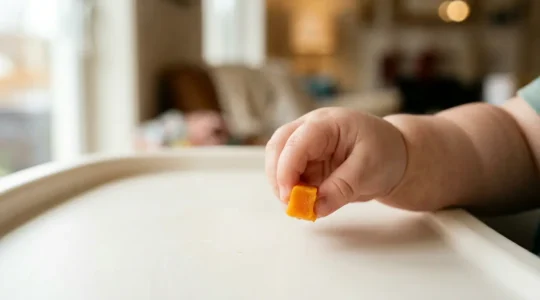
Why the Pincer Grasp at 9 Months Unlocks Self-Feeding and Independence?
The shift from a clumsy whole-hand grab to a precise pincer grasp isn’t just a party trick; it’s the critical milestone that unlocks safe self-feeding and cognitive growth. This skill doesn’t appear overnight but follows a predictable sequence, starting with…
Lire la suite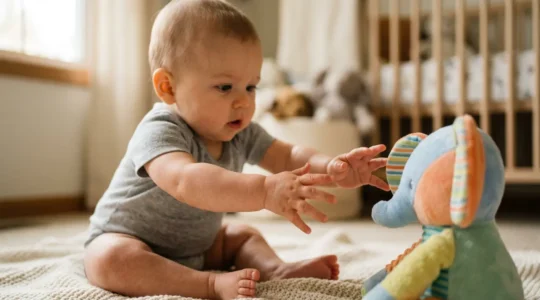
Why Your Baby’s Jerky Arm Movements Become Precise Reaches by Month 6?
Your baby’s journey from a startling reflex grip to purposeful grasping is a neurological masterpiece, not a random process. Each developmental stage, from the palmar grasp to the pincer grasp, is a critical brain-building exercise that lays the foundation for…
Lire la suite
Why Your Baby Screams During Tummy Time and How to Make It Tolerable
In summary: Stop seeing tummy time as one activity. It’s a progressive training system starting with gentle, chest-to-chest contact. Forget long, stressful sessions. « Tummy time snacks »—frequent, 10-60 second bursts—build tolerance without trauma. Your baby isn’t being difficult; they are communicating…
Lire la suite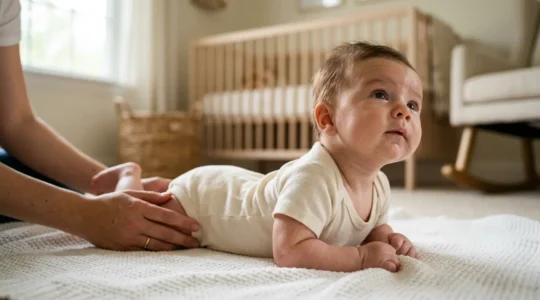
Why Your Newborn’s Wobbly Head Becomes Steady by Week 12 With the Right Support?
Your daily, intentional interactions are the most powerful tool for building your baby’s crucial neck strength and head control. Targeted techniques like specific holding positions and visual tracking are far more effective than passively waiting for a milestone to be…
Lire la suite