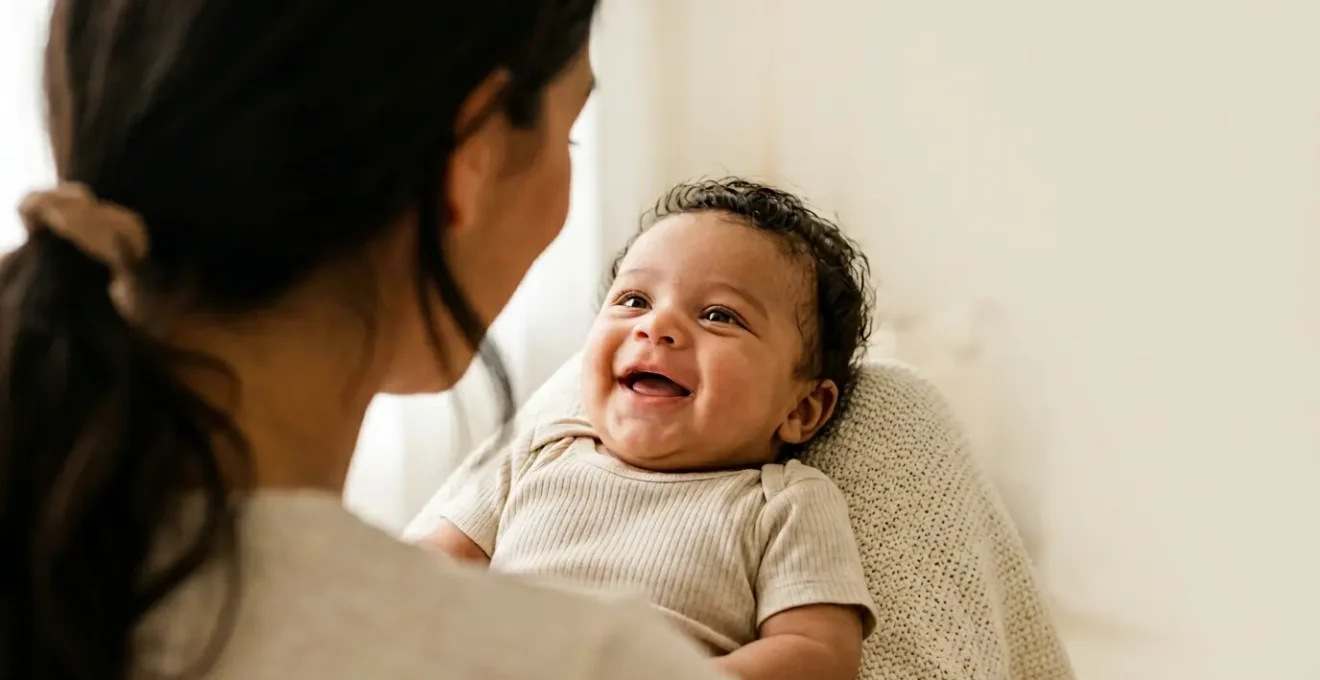
Your baby’s first real smile is not just a heart-melting moment; it’s the most significant neurological breakthrough of their early life, signalling a profound cognitive leap.
- It proves their brain can now recognise your face, process emotion, and intentionally respond.
- It initiates a powerful « serve and return » feedback loop that builds social bonds and accelerates learning.
Recommendation: Prioritise responsive, face-to-face interaction over passive screen time to fuel this critical period of brain development and emotional connection.
As a new parent, you spend hours gazing at your newborn, memorising every tiny feature. You watch them sleep, their face twitching through dreams. Is that a grimace? A flicker of discomfort from wind? Or could it be… a smile? This question occupies the minds of countless parents. We’re often told that early smiles are just « reflexes, » involuntary actions with no emotional meaning. The advice is to simply be patient and wait for the « real thing. »
But what if that first intentional grin, the one that appears right around the six-week mark, is far more than a cute milestone? What if it’s the visible sign of a complex neural network powering on for the very first time? This isn’t just about your baby feeling happy; it’s about their brain making a monumental leap in its ability to perceive, process, and connect with the world. It’s the dawn of their social self.
From a developmental perspective, this social smile is the external signal of an internal revolution. It indicates that the foundational circuits for facial recognition, emotional processing, and social communication are beginning to synchronise. This article will decode the science behind that breakthrough moment. We will explore how to distinguish a reflex from a real social response, what’s happening inside your baby’s brain, and why your face is the most important toy they will ever have.
This guide breaks down the remarkable journey your baby’s brain takes to produce its first real smile. Follow along to understand the science behind this milestone and learn how your interactions shape their developing social and emotional world.
Summary: The Science and Soul of Your Baby’s First Smile
- How to Tell If Your 5-Week-Old’s Smile Is Wind or a Real Response to Your Face?
- Why the Social Smile Means Your Baby’s Brain Can Now Process Faces and Emotions?
- How Face-to-Face Talking and Exaggerated Expressions Draw Out More Social Smiles?
- Why Babies Who See Phones Instead of Faces Smile Less and Vocalise Less?
- When Should You Mention to Your GP That Your 10-Week-Old Has Never Smiled at You?
- When to Transition From High-Contrast Cards to Primary Colours at Week 8?
- Why Your Baby Catches Others’ Emotions Before They Actually Understand Feelings?
- Why Your 10-Month-Old Cries When Another Baby Cries: The Empathy Circuit Activating?
How to Tell If Your 5-Week-Old’s Smile Is Wind or a Real Response to Your Face?
One of the most debated topics in the early weeks of parenthood is the nature of a newborn’s smile. Is it a sign of contentment, a reaction to you, or simply a digestive gurgle? The truth is, the smiles of a very young infant are typically reflex smiles. These are spontaneous, brief, and often occur during sleep or when they are drowsy. They are not a response to anything you are doing but rather a fascinating byproduct of their developing nervous system. These early grins are an important precursor, but they aren’t social… yet.
The transition to a social smile is a true developmental milestone. Unlike a reflex, a social smile is intentional and relational. It happens when your baby is awake and alert, and it’s a direct response to you. You’ll notice it’s different: the smile is broader, it involves their entire face, and their eyes will light up and make direct contact with yours. This is your baby communicating, saying, « I see you, I recognise you, and you make me feel something positive. » According to recent developmental research, most babies produce their first true social smile around 6 weeks of age, though the typical window can range from four to eight weeks.
As developmental paediatrician Dr. Christine Pagano clarifies, there’s a clear distinction between these early expressions and the meaningful connection that follows.
Those primitive, often random grins are indeed different from the social smile that we’ll see weeks later.
– Dr. Christine Pagano, Pediatrician, American Academy of Pediatrics
So, to tell the difference, look at the context. A fleeting smile during sleep is likely a reflex. A sustained smile, accompanied by direct eye contact while you are talking or smiling at them, is the real breakthrough—the beginning of your first two-way conversations.
Why the Social Smile Means Your Baby’s Brain Can Now Process Faces and Emotions?
That first social smile isn’t just a muscular movement; it’s the outward evidence of a profound internal event. It signifies that your baby’s « social brain » is coming online. For the first time, several critical brain regions are working in concert: the visual cortex to see your face, the fusiform gyrus to recognise it as special and distinct from other objects, and the limbic system to attach a positive emotion to that recognition. This is a monumental act of neural synchronization.
In their first month, a baby’s world is a blur of shapes and shadows. But their brain is hardwired to seek out and learn from faces. The social smile is the first clear sign that this system is maturing. It proves your baby can not only see your face but also hold it in their mind and connect it with positive feelings. This is the very foundation of all social learning and emotional bonding. This process continues to develop rapidly; in fact, longitudinal brain imaging research shows that between 6 and 9 months of age infants develop a stronger preference for human faces, and by 10 months, they process facial information holistically, much like adults do.
This complex neural process is the beginning of your baby’s ability to understand the social world. It’s the cognitive milestone that unlocks the door to communication, connection, and empathy.
As you can see in this conceptual representation, the social smile is the result of intricate neural networks activating and connecting. Every time your baby sees your face and smiles, these pathways are strengthened, building a more robust and efficient social brain for life.
How Face-to-Face Talking and Exaggerated Expressions Draw Out More Social Smiles?
Your baby’s brain is primed for social interaction, but it needs a partner to dance with. You are that partner. The emergence of the social smile is not a passive event; it is actively shaped and encouraged by responsive caregiving. This dynamic is what developmental scientists call « serve and return. » When your baby « serves » by looking at you, cooing, or smiling, you « return » by smiling back, talking in an animated voice, and mirroring their expression. This simple back-and-forth is one of the most powerful engines of early brain development.
Why do exaggerated expressions and « parentese » (that high-pitched, sing-song voice) work so well? Because they are perfectly tuned to a baby’s developing sensory system. High-contrast facial expressions (like a wide smile or raised eyebrows) and varied vocal tones are easier for your baby’s brain to register and process. They capture and hold their attention, making the social interaction more engaging and rewarding. This isn’t about « entertaining » your baby; it’s about providing clear, compelling data for their learning brain.
This interaction creates a beautiful feedback loop of joy and bonding. Neuroscience research demonstrates that seeing your smiling baby activates reward centres in your own brain, flooding you with feel-good hormones. Your baby, in turn, picks up on your positive response, which encourages them to smile more. As experts in the field note, this interaction is the crucible of development.
Social smiling emerges out of attentive engagement with an interactive caregiver. This process illustrates the dynamic systems postulate that real-time interaction is a window on developmental process.
– Dr. Daniel Messinger and Dr. Alan Fogel, The interactive development of social smiling
In essence, every game of peek-a-boo, every silly face you pull, and every returned smile is an act of brain-building. You are teaching your baby the fundamental rhythm of human connection.
Why Babies Who See Phones Instead of Faces Smile Less and Vocalise Less?
The « serve and return » dynamic is crucial for development, which powerfully highlights the problem with its absence. What happens when a baby « serves » a social cue, but there is no « return »? The answer lies in a landmark study that provides a stark illustration of an infant’s deep-seated need for emotional reciprocity. When a baby’s attempts at connection are met with a blank, unresponsive face—much like the static face of a parent looking at a phone—the impact is immediate and distressing.
The Still Face Experiment (1975)
In this groundbreaking experiment by Dr. Edward Tronick, a parent is asked to interact playfully with their baby and then, for two minutes, hold a neutral, unresponsive « still face. » The results, replicated countless times, are powerful. Infants quickly become confused and wary. They use all their capabilities—smiling, pointing, cooing—to try and re-engage their parent. When these attempts fail, they show clear signs of distress: they look away, their posture slumps, and they often begin to cry. The experiment powerfully demonstrates that babies have innate expectations for social feedback and are deeply unsettled when those expectations are violated.
The « still face » of the experiment is a powerful analogue for the modern phenomenon of « technoference, » where a parent’s attention is captured by a screen. While checking a phone seems harmless, it creates a digital « still face. » Your baby sees your face, but it’s emotionally unavailable. They receive no return for their social serve. If this happens consistently, a baby may learn to serve less—they may smile less, vocalise less, and make fewer attempts to engage because their efforts are not being rewarded. Research on infant language development also found that when background TV was on, parents spoke less and were more passive in their interactions with their babies.
This isn’t about shaming parents; it’s about understanding the profound importance of undistracted, face-to-face time. Your baby’s brain is learning the rules of social engagement from you. A responsive face teaches them that connection is rewarding, while an unresponsive one can teach them the opposite.
When Should You Mention to Your GP That Your 10-Week-Old Has Never Smiled at You?
As a parent, it’s natural to watch for milestones, and waiting for that first social smile can feel like a long time. It’s important to remember that babies develop at their own pace. The 6-week mark is an average, but the normal range for the first social smile extends to about 8 weeks, and sometimes a little later. A few extra weeks is usually no cause for alarm, especially if your baby was born prematurely (in which case, you should adjust for their due date).
However, if your baby reaches 10 to 12 weeks of age and you have not seen a single intentional smile in response to you, it’s a good idea to mention it at your next check-up with your GP or health visitor. The absence of a social smile can, in some cases, be an early indicator of a developmental issue, such as a problem with vision, hearing, or a broader developmental delay. More often than not, it’s nothing to worry about, but a check-in provides reassurance and ensures any potential issues are caught early.
Before your appointment, it’s helpful to be a prepared observer. Don’t just focus on the smile itself, but on your baby’s overall social engagement. Paying attention to these other behaviours will give your GP a much clearer picture of your baby’s development.
Your Pre-GP Observation Checklist: Social Engagement
- Eye Contact & Tracking: Note if your baby is avoiding eye contact or not tracking your face as you move from side to side.
- Vocalisations: Observe whether your baby is cooing or making other gurgling sounds, especially in response to your voice.
- Responsiveness: Check if your baby responds to other social cues. Do they quieten when you speak or seem to watch your mouth as you talk?
- Interest in Faces: Document whether your baby shows a clear preference for looking at faces over inanimate objects during alert playtime.
- Sensory Concerns: Record any other concerns you have about their hearing (e.g., not startling at loud noises) or vision that might make interaction difficult.
Bringing these specific observations to your GP is far more useful than simply saying « my baby isn’t smiling. » It helps frame the conversation around your baby’s overall social development and allows for a more productive assessment.
When to Transition From High-Contrast Cards to Primary Colours at Week 8?
The development of the social smile is intrinsically linked to another major breakthrough: your baby’s rapidly improving vision. In the first month of life, newborns see the world in shades of grey, black, and white. Their focus is best at about 8-12 inches—coincidentally, the distance from your face when you hold them. This is why high-contrast images, like black-and-white flashcards, are so captivating for them. The sharp contrast is simply easier for their immature visual system to detect.
However, around the two-month mark, their world begins to explode with colour. The cone cells in their retinas, responsible for colour perception, are maturing. They will likely see bold primary colours first, like red and green, with blues and yellows following shortly after. This visual maturation is a critical component of the social smile. For your baby to smile at you, they must first be able to see you clearly. Developmental vision research indicates that by around 6 to 8 weeks, visual tracking improves enough that babies can fixate on a face, follow it as it moves, and maintain that focus.
So, when should you make the switch in visual stimulation? The 8-week mark is an excellent time to begin introducing primary colours alongside high-contrast patterns. You don’t need to discard the black-and-white toys, but you can start to incorporate colourful books, soft toys, and play mats. Watch your baby’s cues. You may notice them starting to fixate for longer on a bright red rattle or a colourful mobile. This is a sign that their brain is ready for and actively processing this new stream of visual information.
This transition is not just about seeing new hues; it’s about the brain learning to interpret a more complex and vibrant world. Providing a mix of both high-contrast and colourful objects supports this entire developmental process, giving their brain the varied diet of stimulation it needs to grow.
Why Your Baby Catches Others’ Emotions Before They Actually Understand Feelings?
Long before your baby understands the complex concept of « happiness » or « sadness, » they can feel it from you. This phenomenon, known as affective contagion or emotional contagion, is the most primitive form of empathy. It’s the tendency to automatically mirror or « catch » the emotions of those around you. When you smile warmly and speak in a gentle, loving tone, your baby’s brain responds in kind, creating a positive feeling state even without a cognitive understanding of the emotion.
This process is deeply biological and is facilitated by a powerful chemical feedback loop. When you and your baby share a smile and eye contact, your brains release hormones that strengthen your connection. Developmental neuroscience has shown that smiles release oxytocin (the « love » or « bonding » hormone) and endorphins in both baby and parent, creating a feedback loop of joy and connection. This chemical reward reinforces the interaction, making both of you want to do it again.
This is why your emotional state is so important. Your baby is an incredibly sensitive barometer of your feelings. If you are stressed, anxious, or sad, they will pick up on the subtle cues—your facial expression, the tension in your body, the tone of your voice—and their own internal state will be affected. Conversely, when you approach them with genuine calm and joy, you are creating an optimal emotional environment for their brain to thrive. You are co-regulating their nascent emotional system.
This isn’t to say you must be perfectly happy all the time—that’s impossible. But it does highlight the power of your presence. By simply sharing a genuine smile, you are doing more than just showing affection; you are sending a cascade of positive neurochemicals through your baby’s brain and teaching them their very first lesson in emotional connection.
Key Takeaways
- The social smile, appearing around 6 weeks, is a major brain development milestone, not just a cute reflex.
- It signifies the baby’s brain can now recognise faces, process emotions, and respond intentionally.
- Responsive, face-to-face interaction (« serve and return ») is critical for encouraging smiles and building the social brain.
Why Your 10-Month-Old Cries When Another Baby Cries: The Empathy Circuit Activating?
The journey that begins with that first social smile is a long and fascinating one, leading directly to the development of complex social emotions like empathy. When your 10-month-old is at a playgroup and bursts into tears simply because another baby started crying, they aren’t just being sensitive. You are witnessing the activation of their empathy circuit, a direct descendant of the early emotional contagion we’ve discussed.
At this stage, they still can’t fully differentiate their own feelings from the feelings of others. The sound of another baby’s distress triggers their own distress network—it’s that same « affective contagion » at work. They hear sadness, and so they feel sadness. This isn’t a cognitive process of « That baby is sad, so I should feel sorry for them. » It’s a much more visceral, reflexive emotional echo. This is a crucial and healthy stage in the development of true empathy.
The social smile is the first step on this path. It establishes the initial pleasurable feedback loop of connection. As your baby grows, their social interactions become more sophisticated. Longitudinal developmental studies demonstrate that social smiles increase in frequency between two and six months and become more communicative. Your baby learns that their smile elicits a positive response from you, and they begin to use it with purpose—to greet you, to share joy, and to maintain a social connection. This understanding that their actions can affect your feelings is the seed of empathy.
By the time they are 10 months old, they have had thousands of these micro-interactions, all of which have strengthened their social brain. They have learned to read facial expressions and vocal tones. So, when they see and hear another baby’s distress, their brain, which has been so well-trained in emotional mirroring, responds in the only way it knows how: by mirroring the emotion. It’s a beautiful, if noisy, sign that their capacity for human connection is growing stronger every day.
Embrace your role as your baby’s first and most important playmate. Every song you sing, every game you play, and every smile you share is actively building a brilliant, compassionate, and social brain, laying the foundation for a lifetime of meaningful connection.