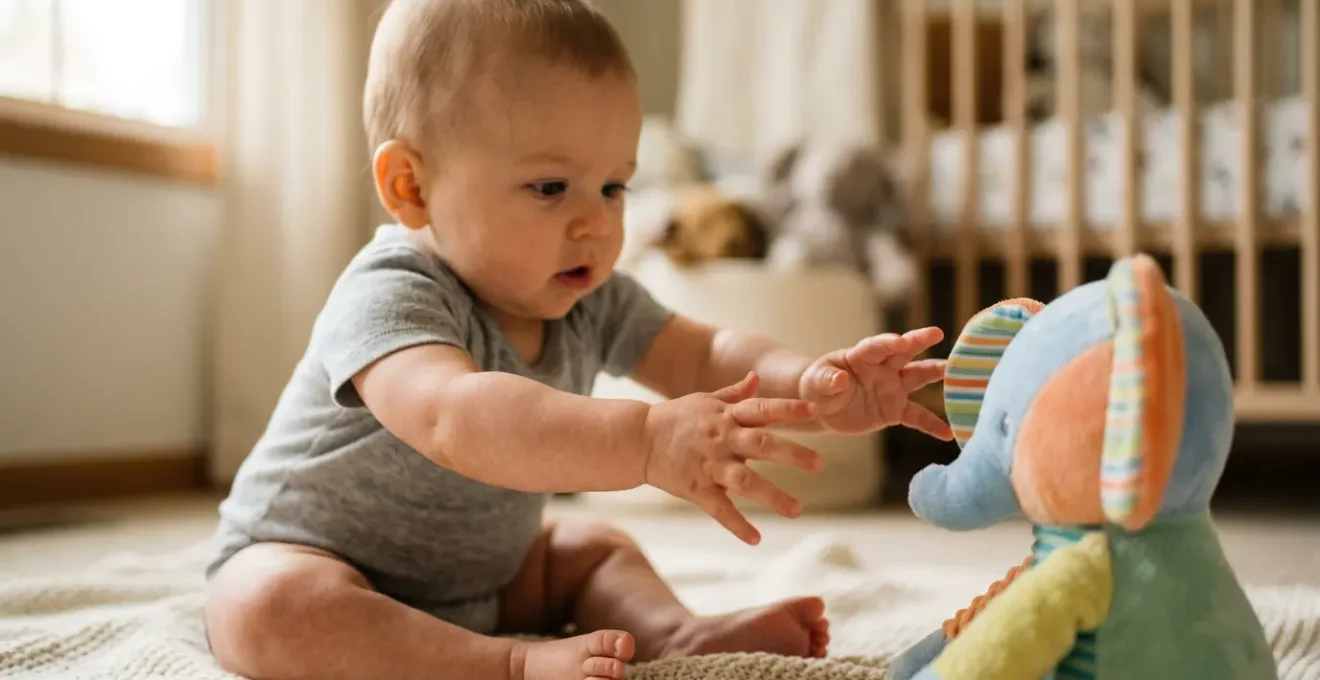
Your baby’s journey from a startling reflex grip to purposeful grasping is a neurological masterpiece, not a random process.
- Each developmental stage, from the palmar grasp to the pincer grasp, is a critical brain-building exercise that lays the foundation for the next.
- Sensory experiences with different textures, weights, and shapes are the essential fuel that builds and strengthens the neural pathways for fine motor control.
Recommendation: Embrace your role as a ‘sensory-motor coach’ by understanding these stages and providing targeted, purposeful play opportunities to support your baby’s incredible development.
Watching your newborn’s tiny hand instinctively wrap around your finger is a magical moment. Yet, a few months later, you might watch that same hand, now jerky and uncoordinated, bat wildly at a toy without being able to grasp it. This transition from a tight, reflexive grip to clumsy swatting can feel puzzling. Many parents wonder when these erratic movements will finally become the precise, deliberate actions of picking up a toy or a snack. It’s a common observation to see babies develop hand control at different paces, leading to questions about what’s normal and how to help.
The typical advice often revolves around simply giving your baby « tummy time » and « different toys. » While well-intentioned, this overlooks the profound neurological construction project happening behind the scenes. The journey from a startle reflex to a skilled pincer grasp is one of the most significant developmental stories of your baby’s first year. It’s not just about muscle development; it’s about the brain learning to perceive, plan, and execute complex commands.
But what if the key wasn’t just waiting for milestones to happen, but understanding the ‘why’ behind each stage? This guide reframes your role from a passive observer to an active, encouraging ‘sensory-motor coach.’ We will explore how each seemingly small step—from that initial finger-squeeze to raking at crumbs—is a vital workout for your baby’s brain. Understanding this process empowers you to provide the precise challenges and experiences your baby needs to build the foundations for a lifetime of skilled interaction with their world.
This article breaks down the incredible journey of your baby’s hand control. We’ll explore the neurological shifts, the right toys for each stage, and the signs that show development is on track. Here’s what we’ll cover:
Summary: From Jerky Swats to Purposeful Grabs: Decoding Your Baby’s Hand Development
- Why Your Newborn Grips Your Finger So Tightly but Cannot Hold a Rattle Yet?
- Which Toys Match the Palmer Grasp at 4 Months vs the Pincer Grasp at 10 Months?
- How Exploring Textures, Weights, and Shapes Builds Your Baby’s Fine Motor Pathways?
- Why Scratch Mittens Past 2 Weeks Delay Your Baby’s Hand Discovery?
- When Should You Seek Assessment If Your 9-Month-Old Cannot Transfer Toys Between Hands?
- Why Your Baby Must Master the Raking Grasp Before the Pincer Grasp Emerges?
- Why the « I Made That Happen » Realisation at 4 Months Changes Everything?
- Why Your Baby’s Face Lights Up When They Shake a Rattle: The Cause-and-Effect Revolution?
Why Your Newborn Grips Your Finger So Tightly but Cannot Hold a Rattle Yet?
That powerful, heart-melting grip of your newborn isn’t a sign of early affection or incredible strength—it’s a primitive reflex. The palmar grasp reflex is an involuntary, pre-programmed response triggered by pressure in the palm. When you place your finger in their hand, their nervous system automatically fires, causing their fingers to curl and clamp down. This is pure reflex; there is no conscious thought or intention behind it. This is why they can grip your finger with surprising force but cannot yet purposefully hold, let alone shake, a rattle. The brain centres for voluntary control simply haven’t come online yet.
Think of this reflex as the factory-installed operating system. It’s a foundational piece of programming that ensures the baby has the basic mechanics of gripping from day one. As a paediatric OT, I see this as the very first step in a long and beautiful sequence of development. As StatPearls medical research notes, this innate reaction is not just a relic of evolution but a crucial starting point for what comes next.
The palmar grasp reflex probably creates a basic motor pattern that lays the foundation for obtaining this voluntary ability.
– StatPearls Medical Research, Grasp Reflex – StatPearls NCBI Bookshelf
Over the first few months, as your baby’s brain matures, this reflex will begin to fade, making way for voluntary movement. The jerky, uncontrolled arm movements you see are actually a positive sign! They show the higher-level parts of the brain are starting to take over from the primitive reflexes, attempting to send signals to the arms and hands. It’s a messy, trial-and-error process, but it’s the very beginning of purposeful action.
Which Toys Match the Palmer Grasp at 4 Months vs the Pincer Grasp at 10 Months?
As your baby’s reflexive grip gives way to voluntary control, the type of « work » they need to do changes. Your role as a sensory-motor coach is to provide the right equipment—in this case, toys—for each stage of this neurological construction project. Matching the toy to the current grasp pattern is key to providing a satisfying challenge that builds skills without causing frustration.
Around 4-6 months, your baby is mastering the palmar grasp. They use their whole palm and all their fingers (without the thumb being involved separately) to hold objects. Their goal is to get the object into their hand and, most likely, to their mouth. At this stage, the best toys are those that are easy to grab and hold with a full-fist grip. A thin, hard rattle might be difficult, but a toy with a larger, softer handle is perfect.
By 9-12 months, a much more refined skill emerges: the pincer grasp. This is the hallmark of fine motor precision, using the tips of the thumb and index finger to pick up small items. This ability opens up a new world of exploration and self-feeding. To encourage this, you need to offer opportunities that require this delicate movement. Here is a simple progression:
- 4-6 months (Palmar Grasp): Offer large soft blocks, lightweight textured rattles, and O-ball toys. These are easy to clutch with the whole hand.
- 6-8 months (Raking Grasp): Introduce soft finger foods (like banana pieces on a highchair tray) that they can rake towards their palm with their fingers.
- 9-10 months (Inferior Pincer Grasp): Provide puzzles with large knobs, chunky board books, and soft blocks. They will use the pads of their thumb and finger.
- 11-12+ months (Superior Pincer Grasp): Offer activities requiring fingertip control, like picking up small puffs of cereal, posting games (placing « coins » in a slot), or peeling sticky notes off a surface.
Each stage builds directly on the last. By providing these age-appropriate challenges, you are helping your baby build the strength, coordination, and brain connections needed for the next level of skill.
How Exploring Textures, Weights, and Shapes Builds Your Baby’s Fine Motor Pathways?
A baby’s hands are their primary tools for learning about the world. They are like tiny sensory scientists, and every object they touch is a data point. When a baby feels the fuzzy surface of a soft toy, the cool smoothness of a wooden block, or the bumpy texture of a teething ring, they aren’t just playing. They are sending a torrent of rich sensory information directly to their brain. This information is the raw material for building a sophisticated « library » of touch.
This process is far more than simple exploration; it’s a critical part of neurological construction. Each new texture, weight, and shape sends electrical signals up the nerves to the brain. These signals stimulate the growth of myelin, a fatty substance that acts like insulation around the brain’s « wiring. » As a study in the Journal of Neuroscience highlights, this myelin sheath is what allows for fast, efficient communication between different parts of the brain. The more varied the sensory input, the more robust these pathways become. This is how the brain learns to differentiate a soft blanket from a hard floor, and eventually, how to apply just the right amount of pressure to pick up a delicate raspberry without squashing it.
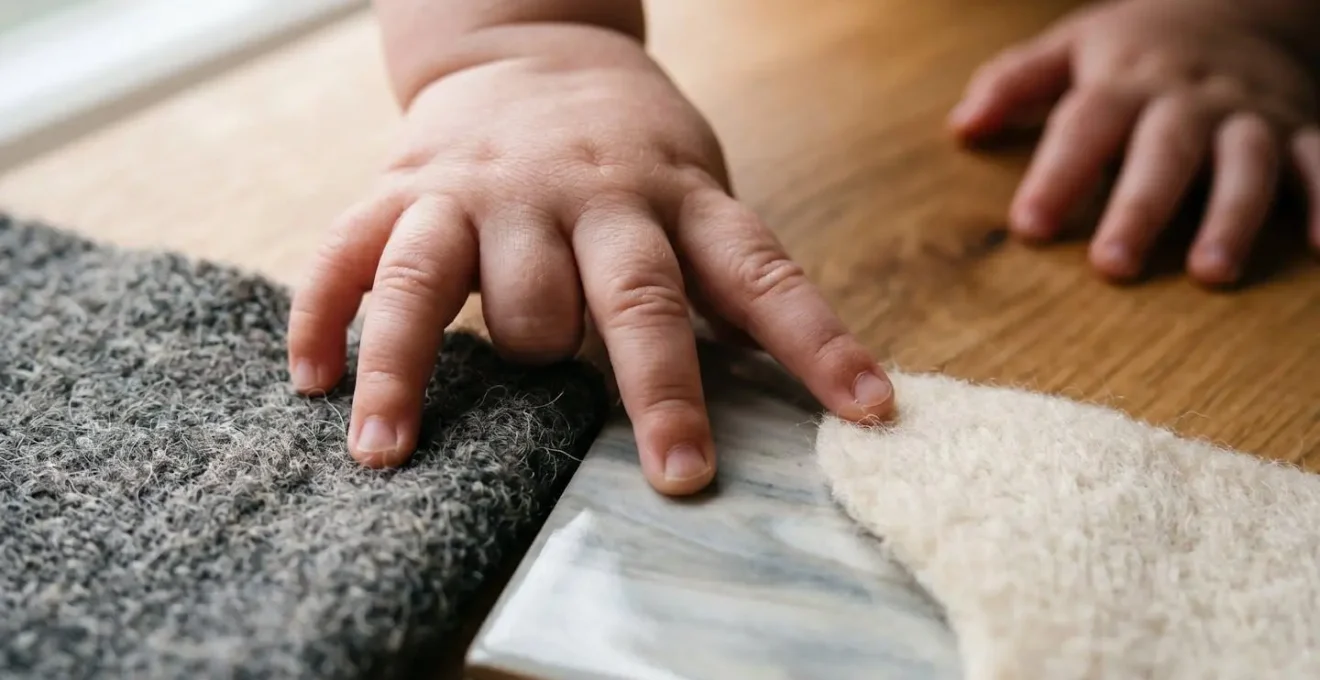
As the image above beautifully illustrates, this tactile exploration is a multi-faceted experience. By providing a « sensory diet » rich in variety—crinkly books, silky scarves, bumpy balls, cool metal spoons (under supervision)—you are actively helping your baby build a more complex and capable brain. You are giving their hands a rich vocabulary to understand and interact with the world. This foundation is essential for everything from buttoning a coat to writing their name years down the line.
Your Sensory Environment Audit: A 5-Point Checklist
- Texture Variety: List all the play items your baby regularly touches. Do they have a range of textures (smooth, rough, bumpy, soft, fuzzy, crinkly)?
- Weight & Shape Diversity: Inventory their toys. Are there different weights (light, heavy) and shapes (round, square, complex) that encourage different ways of holding?
- Material Mix: Note the materials your baby interacts with. Is it all plastic, or do they also get to experience wood, metal, fabric, and natural objects (like a smooth stone or a large leaf, always supervised)?
- Hand-Mouth Connection: Observe their play. Are the safe-to-mouth toys easily distinguishable and accessible, allowing them to use their mouth as a second sensory tool for exploration?
- Integration Plan: Identify one missing sensory experience from your audit and plan how to introduce a new, safe object this week to fill that gap.
Why Scratch Mittens Past 2 Weeks Delay Your Baby’s Hand Discovery?
In the first couple of weeks, scratch mittens serve a clear purpose: to protect a newborn’s delicate skin from their own uncontrolled, reflexive movements. As we’ve seen, they don’t have voluntary control yet, and those tiny nails are sharp! However, continuing to use them beyond this initial period can inadvertently hinder a crucial phase of development: hand discovery.
Around the 4-to-6-week mark, your baby will begin to notice their own hands. You might see them staring at them intently, bringing them together, and eventually bringing them to their mouth. This is a monumental cognitive leap! It’s the beginning of body awareness—the understanding that these two fascinating things are a part of *them* and they can control them. This discovery is a primary driver for developing voluntary motor skills. They are motivated to move their hands because they are so interesting!
Covering their hands with mittens effectively sensory-deprives them during this critical window. It’s like trying to learn about the world while wearing thick gloves. They can’t feel the texture of their own skin, the warmth of your hand, or the shape of a toy. This mutes the rich sensory feedback we discussed earlier, feedback that is essential for building those brain pathways. The palmar grasp reflex disappears by around 6 months in normal development precisely because voluntary, sensory-led exploration is meant to take its place. Keeping hands covered can delay this natural transition.
So, what’s the alternative to preventing scratches? The simplest solution is to keep your baby’s nails trimmed and filed short. This addresses the scratching problem at its source while leaving their hands free to do their important work of discovery. Freeing the hands allows them to touch, feel, explore, and learn, setting the stage for all the fine motor skills that are to come. It’s a small change that can make a big difference in their developmental journey.
When Should You Seek Assessment If Your 9-Month-Old Cannot Transfer Toys Between Hands?
As a parent, it’s natural to watch for milestones. But it’s crucial to remember that these are not rigid deadlines but developmental « windows. » Every baby follows their own unique timeline. However, some skills are key indicators of underlying neurological progress, and their absence can warrant a conversation with a professional. One such skill is the ability to transfer an object from one hand to the other, which typically emerges between 6 and 9 months.
Why is this seemingly simple action so important? As paediatric motor development specialists point out, « Transferring an object is a key indicator of the two brain hemispheres communicating effectively across the corpus callosum. » When your baby passes a block from their right hand to their left, it’s a physical sign that the left and right sides of their brain are working together. It requires one hand to intentionally let go while the other intentionally takes hold—a complex, coordinated sequence that is a huge step up from simply holding an object.
If by 9 months your baby is consistently not bringing their hands together at the midline, not reaching for toys with both hands, or is unable to pass a toy from one hand to the other, it’s a good idea to bring it up. This doesn’t automatically mean there is a problem. It could simply be their personal timeline. But it’s worth a chat. In the UK, your Health Visitor is the perfect first point of contact. They can assess your baby’s overall development and offer reassurance or guidance. It’s also worth noting that the American Academy of Pediatrics recommends developmental screening at the 9-month check-up, highlighting this as a key period for observation.
Other things to look for include a strong preference for one hand over the other before 12 months, or keeping one hand persistently fisted while the other is open. Bringing these specific, calm observations to your Health Visitor or GP is far more productive than general worrying. It allows you to be a proactive partner in your child’s health, armed with knowledge and ready to seek support if needed.
Why Your Baby Must Master the Raking Grasp Before the Pincer Grasp Emerges?
In the grand construction project of fine motor skills, you can’t install the windows before the walls are up. The raking grasp is a critical « wall-building » phase that must happen before the more refined « window » of the pincer grasp can be installed. Around 6-8 months, you’ll see your baby start to approach small objects, like a puff of cereal, with an open hand, using all their fingers like a rake to sweep the object into their palm.
It can look clumsy and inefficient to us, but it’s a brilliant and necessary strategy. At this stage, the brain has not yet figured out how to isolate the thumb and index finger. The raking motion is the baby’s solution to the problem: « How do I get that small thing into my hand when I can only move all my fingers at once? » It’s a demonstration of problem-solving in action and a vital workout for the muscles in the hand and forearm. Each raking attempt strengthens the hand and sends sensory information to the brain about distance, shape, and texture.
This stage is non-negotiable. It must be mastered before the pincer grasp can emerge. Developmental research shows a clear timeline: the raking grasp develops around 6-7 months, a full 2-3 months before the pincer grasp solidifies at 9-10 months. Trying to rush this process or force pincer-style activities too early will only lead to frustration. Instead, as a sensory-motor coach, you should embrace and encourage the rake!
The best way to do this is by placing small, soft, baby-safe finger foods on their highchair tray. The large, stable surface gives them the perfect arena to practice their raking. They will rake, trap the food in their palm, and then bring their whole fist to their mouth. It’s messy, but it’s purposeful, skill-building mess. By allowing them to master the rake, you are giving their brain and hands the exact practice they need to lay the groundwork for the delicate pincer grasp to come.
Key takeaways
- Your baby’s motor development is a predictable sequence, where involuntary reflexes are replaced by purposeful, learned skills.
- Sensory exploration is not just play; it’s the primary way your baby’s brain builds the complex neural networks required for fine motor control.
- Your role as a parent is to be an informed ‘coach’, providing the right environment and age-appropriate challenges to support each developmental stage.
Why the « I Made That Happen » Realisation at 4 Months Changes Everything?
Around 4 months, a profound cognitive shift begins to happen. Your baby, who has been randomly swatting at objects, accidentally makes a mobile jingle or a rattle shake. For a moment, they pause. Then, they try to do it again. When they succeed, their face might break into a look of pure delight and concentration. This is more than just a reaction to a sound; it’s the dawning of a revolutionary idea: « I made that happen. » This is the birth of understanding cause and effect.
This realisation is the foundation of agency and self-efficacy—the belief that one can have an effect on the world. As developmental psychology researchers note, the joy a baby shows isn’t just about the rattle’s sound; it’s the thrill of having control. For the first time, their actions are not just random movements but have predictable, interesting consequences. This is incredibly motivating! It’s the « why » that will drive them to practice their motor skills relentlessly for the coming months. They will shake, bang, and drop things over and over, not just to be noisy, but to test this amazing new power.
This link between action and outcome is not just a psychological boost; it has measurable effects on cognitive development. A groundbreaking 2025 study in Pediatric Research found that advanced motor skills in infancy are directly linked to higher scores in pre-linguistic development. In simple terms, babies who have more opportunities to act on their world and see the results are also building the framework for communication. Their ability to make things happen with their hands helps their brain learn the patterns of interaction and consequence that are also fundamental to language.
As their coach, you can foster this by providing toys that give clear feedback. A rattle that makes a noise, a toy that lights up when hit, or a crinkly book that makes a sound when grabbed are all perfect tools for this stage. You are reinforcing the powerful and motivating lesson that their actions matter.
Why Your Baby’s Face Lights Up When They Shake a Rattle: The Cause-and-Effect Revolution?
That radiant smile that spreads across your baby’s face when they successfully shake a rattle is the visible evidence of a « revolution » happening in their brain. It’s the powerful, rewarding feedback loop of cause and effect in action. The sequence is simple: they perform an action (move their arm), it creates a result (the rattle makes a sound), and their brain is flooded with a sense of accomplishment and delight. This is the engine of learning.
This loop—action, result, reward—is a fundamental driver of human behavior, and it starts here, in the highchair. Each time they repeat the action and get the same result, they are not just playing; they are running a scientific experiment. They are confirming their hypothesis: « When I do this, that happens. » This process strengthens the neural connections responsible for motor planning, coordination, and an understanding of the physical world. It’s the groundwork for all future problem-solving.
The importance of this early motor development extends far beyond just hand skills. It is deeply intertwined with overall cognitive function. We can no longer think of motor skills as separate from « brainy » skills like language or problem-solving. They are all part of the same integrated system. Encouraging motor exploration is, in fact, a form of early brain training. This is supported by significant research; for example, longitudinal research from the Upstate KIDS study demonstrates that achieving gross motor milestones earlier is associated with favorable long-term effects on adaptive and cognitive skills in childhood.
Therefore, when you see your baby endlessly banging a spoon on their tray or shaking a rattle with joyous abandon, know that you are witnessing something profound. You are seeing a brain being built in real-time. You are seeing the birth of intention, agency, and a lifelong love of learning. Your encouragement and provision of a safe, stimulating environment are the most important contributions you can make to this incredible cause-and-effect revolution.
Embrace your role as your baby’s primary sensory-motor coach. Enjoy witnessing this incredible neurological masterpiece unfold, one tiny, purposeful grasp at a time. By understanding the process, you can confidently provide the support and encouragement they need to build their skills and their brain.