
In summary:
- Stop seeing tummy time as one activity. It’s a progressive training system starting with gentle, chest-to-chest contact.
- Forget long, stressful sessions. « Tummy time snacks »—frequent, 10-60 second bursts—build tolerance without trauma.
- Your baby isn’t being difficult; they are communicating a skills gap. Your job is to bridge that gap with the right support.
- Distraction is a strategy. Use high-contrast cards and mirrors to engage their developing brain and build neck strength simultaneously.
You’ve read the articles, seen the posts, and heard the advice from every health visitor: tummy time is essential. So you diligently place your baby on their mat, and within seconds, the screaming starts. That red-faced, full-body protest that makes you feel like a monster. You’ve tried toys, you’ve tried singing, and you’ve tried waiting it out, but the distress is too much. You scoop them up, feeling defeated, and think, « Maybe we’ll try again tomorrow. » For many UK parents, tomorrow never comes, and tummy time is quietly abandoned, filed under « things my baby just hates. »
The common advice to « start with short sessions » or « use distractions » often fails because it misses the fundamental point. Your baby isn’t just being fussy; they are communicating that the task’s demand exceeds their current physical capacity. It’s like asking an adult who has never run before to complete a 5k. The solution isn’t to just tell them to « tolerate it. » The solution is a structured training plan.
But what if the key wasn’t about making your baby tolerate something they hate, but about re-engineering the entire process? What if you could stop seeing tummy time as a single, dreaded event and start treating it as a system of progressive skill-building? As a paediatric occupational therapist, I can tell you that you are not failing, and your baby is not broken. You just need a better strategy, one that builds capacity step-by-step, turning screams of frustration into grunts of effort and, eventually, the proud mastery of head control.
This guide will walk you through that exact strategy. We will break down why skipping this phase has long-term consequences, then provide a clinical, problem-solving framework to build tolerance from the ground up, starting with just ten seconds of effort. Forget the one-size-fits-all advice; it’s time for a professional approach.
Summary: A Therapist’s Guide to Successful Tummy Time
- Why Skipping Tummy Time Leads to Flat Head Syndrome and Delayed Crawling?
- How to Do Tummy Time on Your Chest When Your Newborn Cannot Lift Their Head Yet?
- When to Move From Chest Tummy Time to Floor Time to Supported Prop Positions?
- Why 10 Seconds Five Times Daily Builds More Tolerance Than One 5-Minute Session?
- How a Mirror, Sibling, or Singing Parent Doubles Tummy Time Tolerance Instantly?
- Why Every Later Milestone Depends on Your Baby Mastering Head Control First?
- How to Use High-Contrast Cards During Tummy Time to Double the Developmental Benefit?
- Why Black and White Cards Capture Your Newborn’s Attention Better Than Colourful Toys?
Why Skipping Tummy Time Leads to Flat Head Syndrome and Delayed Crawling?
When your baby is screaming, it’s tempting to rationalise that skipping tummy time isn’t a big deal. However, the consequences are not just cosmetic; they create a developmental domino effect. The most immediate risk is positional plagiocephaly, or « flat head syndrome. » Since the « Back to Sleep » campaign rightfully reduced SIDS rates, babies spend much more time on their backs. Without the counterbalance of tummy time, the soft bones of the skull can flatten. This is far from a rare occurrence; recent data shows that nearly 47% of infants now have some degree of plagiocephaly.
Beyond the head shape, tummy time is the primary engine for building the foundational strength in the neck, shoulders, and upper back. These are the muscles that enable your baby to lift their head, which is the first step in a long chain of gross motor skills. Without this foundational head control, subsequent milestones like rolling over, pushing up, sitting unsupported, and eventually crawling are all delayed. Each skill builds directly upon the last. This isn’t just theory; it’s a well-documented sequence.
The Developmental Domino Effect in Action
This connection is clinically proven. A major 2020 systematic review in the journal *Pediatrics* examined multiple studies on infant health. The findings were unequivocal: infants who had regular tummy time achieved key milestones like rolling, sitting, and crawling significantly earlier. Conversely, a lack of tummy time was directly correlated with delays across the board. The study illustrates how head control isn’t an isolated skill but the first critical domino that must fall to trigger the entire sequence of your baby’s physical development.
Thinking about it this way reframes the issue. You are not just avoiding a flat spot; you are laying the literal groundwork for your child’s ability to explore their world. The temporary discomfort of tummy time is an investment that pays dividends for every single milestone to come.
How to Do Tummy Time on Your Chest When Your Newborn Cannot Lift Their Head Yet?
The mistake most parents make is starting with « floor time. » For a newborn with zero head control, being flat on the floor is overwhelming. The force of gravity is too great, their face is mashed into the carpet, and panic is a natural response. The real starting point is you. Using your body as the environment is safer, more reassuring, and biomechanically less demanding.
This is Stage Zero: chest-to-chest tummy time. By reclining with your baby on your chest, you reduce the angle and therefore the gravitational pull they are working against. They feel your heartbeat, hear your voice, and smell your scent, which co-regulates their nervous system and reduces stress. From this position of safety, they can begin to experiment with tiny head lifts. It’s the most gentle and effective introduction to the work they need to do.

As you can see, this position is about connection as much as it is about exercise. Your hands provide security, and your body provides a warm, supportive, and slightly inclined surface. This isn’t just an « alternative » to tummy time; for a newborn, this is tummy time. The goal is to gradually increase the angle of your recline over days and weeks, making the work progressively harder as your baby gets stronger. This gradual increase in challenge is the core principle of building capacity without causing distress.
When to Move From Chest Tummy Time to Floor Time to Supported Prop Positions?
Graduating from your chest to the floor isn’t determined by your baby’s age, but by their demonstrated ability. Pushing them to the next stage before they are ready will only bring back the screaming and set you both back. You need to become an expert observer, looking for specific physical cues that signal they have built enough strength and tolerance to handle a new challenge. Think of it as a promotion they have to earn through effort.
The key indicators are a mix of strength, endurance, and attitude. When your baby can consistently lift their head to a 45-degree angle while on your chest and hold it for more than a few seconds without collapsing, that’s a major sign of readiness. You’ll also notice them starting to use their arms, pushing up on their forearms rather than keeping them tucked underneath. This « swimming » motion shows they are developing the strength in their shoulder girdle needed for the floor. Just as importantly, their emotional response will have shifted from instant panic to neutral or even curious tolerance. These signs tell you they are ready for the next level.
Your Tummy Time Readiness Checklist: Key Cues to Watch For
- Head Lift Mastery: Can your baby consistently lift their head to a 45-degree angle during chest time and hold it for 10-15 seconds without trembling or sudden collapse?
- Arm Activation: Have they started making ‘swimming motions’ or pushing with their forearms, instead of keeping arms trapped under their body?
- Tolerance Shift: Has their immediate fussing upon being placed on your chest changed to a neutral or positive tolerance for at least 30-60 seconds?
- Active Looking: Are they demonstrating increased head-turning ability, actively looking from side to side to track your voice or an object while on their tummy?
- Floor Test: When placed briefly on the floor, can they maintain a brief head lift for 5-10 seconds, showing they are ready to begin practice there?
Once they show these signs, you can introduce supported positions on the floor. This doesn’t mean going straight to a flat mat. It means using props to provide a « scaffold » for their efforts, just as your chest did before. This is where a systematic use of props becomes a powerful therapeutic tool.
The « Prop Pyramid » helps you choose the right support for their current ability, gradually decreasing it as they get stronger. You start with maximum support and work your way down.
| Support Level | Prop Type | Biomechanical Benefit | Best Age Range |
|---|---|---|---|
| Maximum Support | Nursing pillow under armpits and chest | Elevates torso 20-30 degrees, significantly reduces neck muscle load, allows baby to focus on visual engagement rather than weight-bearing | 6-10 weeks |
| Moderate Support | Rolled towel under chest | Provides 10-15 degree elevation, gentle incline helps baby experiment with weight shift while building strength gradually | 10-14 weeks |
| Minimal Support | Parent’s leg (baby lying across thighs) | Creates slight arch that opens chest, encourages baby to use back muscles while parent provides stabilization and comfort | 12-16 weeks |
| Dynamic Support | Water play mat or sensory mat | Unstable surface activates core stabilizers, promotes micro-adjustments in muscle engagement, stimulates proprioception | 14+ weeks (with supervision) |
Why 10 Seconds Five Times Daily Builds More Tolerance Than One 5-Minute Session?
The advice to « aim for 5 minutes of tummy time » is where many parents fail. For a baby who hates it, five minutes is an eternity of torture for both of you. The key to building tolerance is not duration, but frequency and positive reinforcement. This is the concept of « Tummy Time Snacks » or micro-dosing. It’s about providing very short, high-quality bursts of effort spread throughout the day.
Think of it like strength training. A baby’s muscles fatigue incredibly quickly. Forcing them to stay in a position after they’ve hit their limit only builds a negative association with the activity. It teaches them that tummy time is distressing and something to be resisted. However, a 10-second « snack » allows them to work their muscles to near-fatigue, and then you rescue them before the screaming starts. This builds trust and a positive association. They learn that this is a manageable challenge, not an endless ordeal.
While the long-term goal might be substantial, as the World Health Organization recommends at least 30 minutes of tummy time daily for infants, you don’t get there in one go. You get there by accumulating dozens of these tiny, successful sessions. Eight sessions of 15 seconds each is two minutes of high-quality work, achieved with zero tears. That’s infinitely more productive than one five-minute session that ends in a meltdown. The trick is to integrate these snacks into your existing daily routines, so they become an automatic habit.
Here is a sample schedule. The goal is not to follow it rigidly, but to understand the principle of « habit stacking »—linking the new habit (tummy time) to an existing one (diaper change).
- The Diaper Change Flip (5+ sessions daily): After every nappy change, before re-dressing, flip your baby onto their tummy on the changing mat for 10-20 seconds. You’re already there, it’s a soft surface, and it’s a perfect opportunity.
- The Post-Nap Stretch (2-3 sessions daily): When your baby wakes, they are usually calm and alert. This is a great time for a 30-60 second tummy time session on your chest or a play mat.
- The Pre-Feed Face Time (3-4 sessions daily): Before a feed (but not when they’re frantically hungry), do a quick 15-30 second session on the floor, getting down to their eye level to engage them.
- The Bath Prep Position (1 session daily): While getting ready for a bath, place your baby on a warm towel on the floor for a minute of tummy time. The warmth and prospect of the bath can be calming.
How a Mirror, Sibling, or Singing Parent Doubles Tummy Time Tolerance Instantly?
Once you’ve established the « tummy time snacks » routine, the next step is to make those short bursts as engaging as possible. A baby lying on a plain carpet has little motivation to lift their heavy head. Their world is the texture of the rug, two inches from their nose. Your job is to give them a compelling reason to do the hard work of looking up. This is where you move from being a coach to being a creative director, curating a « Sensory Menu » to capture their attention.
The three most powerful motivators for an infant are visual, auditory, and social stimuli. Providing the right kind of input in these categories can instantly extend a 15-second session to 30 seconds or more. A baby-safe, unbreakable mirror placed in front of them is one of the most effective tools. Babies are fascinated by faces, and their own reflection provides captivating, responsive feedback to their movements. Similarly, the sound of a parent’s voice, singing or simply talking in an animated way from their eye level, provides powerful social and auditory encouragement. The goal is to make the world at eye level more interesting than the floor.
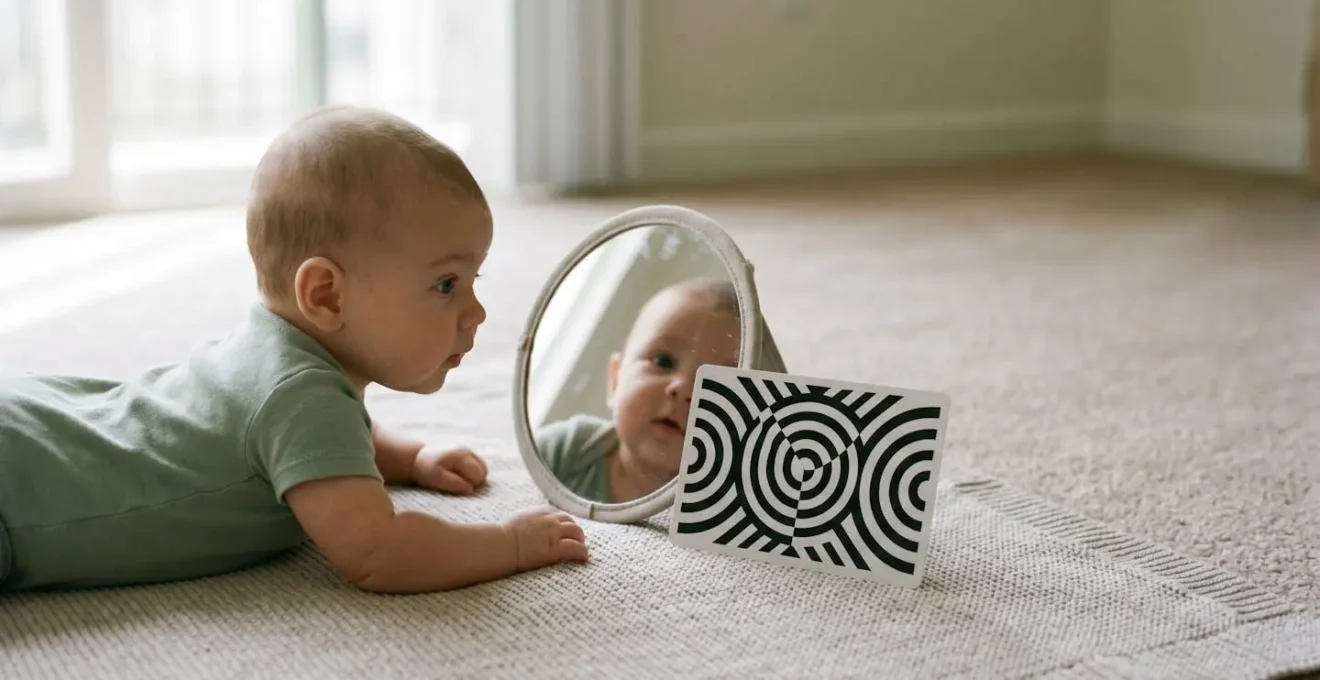
The key is to offer variety and discover what your unique child responds to. This isn’t just « distraction »; it’s targeted neurological engagement. You are activating their developing visual and auditory cortices, which in turn motivates the motor output of lifting their head. A crinkly toy provides a different kind of auditory and tactile feedback than a soft rattle. A sibling lying face-to-face offers a unique social connection. By systematically trying different tools, you can build a menu of effective strategies.
This table outlines a structured « Sensory Menu » you can use to find what captures your baby’s interest and doubles their engagement.
| Sensory Category | Engagement Tools | Neurological Benefit | Age Suitability |
|---|---|---|---|
| Visual | High-contrast black/white cards, unbreakable baby-safe mirror, bubbles floating at eye level, water mat with floating shapes | Activates developing visual cortex, encourages head turning and tracking, supports focus and attention span | 0-6 months |
| Auditory | Parent singing at specific pitch, crinkle paper sounds, white noise at 50-60 decibels, soft rattles | Parent’s voice regulates baby’s heart rate, rhythmic sounds reduce stress response, novel sounds promote alertness | 0-6 months |
| Tactile | Different textured blankets (silk, faux fur, corduroy, ribbed cotton), slightly warmed towel, textured sensory balls | Stimulates touch receptors, builds sensory discrimination, provides comfort through varied textures reducing monotony | 2-6 months |
| Social | Sibling lying face-to-face, parent at eye level making expressions, family pet (supervised) nearby | Activates mirror neurons and social brain regions, promotes emotional regulation through familiar faces | 2-6 months |
Why Every Later Milestone Depends on Your Baby Mastering Head Control First?
Head control is the cornerstone of all future movement. It is not just one skill among many; it is the fundamental prerequisite for everything that follows. Until a baby can confidently lift, turn, and hold their head steady, their ability to intentionally interact with the world is severely limited. They cannot visually track objects, bring hands to their mouth in a coordinated way, or shift their weight to roll over. They are, in essence, trapped by gravity.
As the experts at Lovevery state, this is a non-negotiable developmental step:
Head control is an important first motor skill that your baby must gain before they learn to roll over, sit, crawl, and, eventually, walk.
– Lovevery Child Development Experts, Lovevery Blog – Head Control Development Guide
Think about what head control enables. Once a baby can lift their head, they can look around, which motivates them to reach. Once they can turn their head, they can shift their centre of gravity, which is the first step in learning to roll. Once they can hold their head up while on their forearms, they are building the upper body strength needed to push up into a sitting position. And once they can control their head and trunk while on all fours, they are ready to crawl. Every single step is mechanically dependent on the one before it. This is why paediatric therapists are so persistent about tummy time: we see the entire developmental ladder, and we know that the first rung is head control.
This mastery doesn’t happen overnight. It’s a gradual process of strengthening, and while every baby develops at their own pace, developmental research indicates that by 6 months old, most babies have full head control. Tummy time is the work that gets them there. By understanding this, you can see that you’re not just enduring a difficult phase; you are actively constructing your child’s physical future.
How to Use High-Contrast Cards During Tummy Time to Double the Developmental Benefit?
Simply placing high-contrast cards near your baby is a good start, but actively using them as a therapeutic tool can transform a passive look into an active workout. Using cards is not just for distraction; it’s a technique to encourage specific, muscle-building movements. The goal is to facilitate « visual tracking, » encouraging your baby to move their head—and therefore strengthen their neck—by following the card with their eyes.
The key is to work within their optimal visual range, which for a newborn is about 8-12 inches from their face. You want to be close enough for them to focus clearly, but far enough that they have to turn their head to follow the movement. This requires you to be an active participant in the session, acting as a trainer guiding them through a set of exercises. This turns a simple tummy time « snack » into a highly productive, multi-system workout that builds both visual processing skills and motor strength simultaneously.
By making it a game, you create positive associations and can significantly extend the duration of their effort before fatigue or frustration sets in. Here is a step-by-step technique for an active tracking session.
Action Plan: Active Tracking with High-Contrast Cards
- Positioning and Focus: Place your baby in a stable tummy time position (e.g., on a mat with a rolled towel for support). Hold a high-contrast card 8-12 inches from their face. Wait for their gaze to lock onto the image.
- Horizontal Tracking: Once they are focused, very slowly move the card horizontally to the right. Pause. Watch them turn their head to follow. Return to the centre, then repeat on the left side. This builds the neck rotator muscles.
- Vertical Tracking: From the centre, slowly move the card upwards. This encourages them to lift their head higher against gravity, strengthening the crucial neck extensor muscles. Pause, then return to eye level.
- Auditory Integration: As their eyes lock onto the card, gently tap it and make a soft, distinct sound (like a ‘boop’ or a ‘click’). This links sound to sight, creating cause-and-effect learning and keeping them engaged.
- Pattern Progression: Start the session with simple patterns like bold stripes or circles. Mid-session, switch to more complex patterns like checkerboards or spirals. End with a card showing a stylized face, which is often the most engaging image for an infant.
This active technique does more than just buy you a few more seconds of peace. It strategically targets the exact muscles your baby needs to develop for head control, all while stimulating their brain’s visual pathways.
Key takeaways
- Tummy time is not a single activity but a progressive system; start on your chest, not the floor.
- Embrace « Tummy Time Snacks »: frequent, 10-60 second sessions are more effective than one long, stressful one.
- Your baby’s protest is a signal of a skills gap, not defiance. Your role is to bridge this gap with support and structured challenges.
Why Black and White Cards Capture Your Newborn’s Attention Better Than Colourful Toys?
It can seem counterintuitive. We fill our nurseries with soft pastels and brightly coloured toys, yet the most effective visual tool for a newborn is a simple black and white piece of card. This isn’t a matter of aesthetic preference; it’s a matter of neuro-ophthalmological development. A newborn’s vision is one of their least developed senses at birth, and they see the world in a very different way than we do.
The primary reason is biological. As vision specialists explain, the anatomy of their eye is still under construction.
The cones in their retinas, responsible for seeing colors, aren’t fully developed yet, which limits their ability to see the full range of shades.
– Northwest Eye Clinic Vision Specialists, Northwest Eye Clinic – Understanding Infant Vision
Their world is blurry and lacks colour saturation. A low-contrast pink rattle against a beige blanket might as well be invisible. The rods in their eyes, however, which detect light, dark, and movement, are far more functional. A high-contrast boundary between pure black and pure white sends the strongest possible signal to their developing brain. It’s clear, it’s sharp, and it’s attention-grabbing. This is why bold, simple geometric shapes in black and white are so captivating for them.
Furthermore, their ability to focus is limited. While an adult can see clearly at many distances, research on newborn vision shows that babies can see most clearly at 8-10 inches away—roughly the distance from their face to a parent’s face when being held or fed. This is no coincidence; it’s hard-wired to promote bonding. When using high-contrast cards, placing them within this 8-10 inch « sweet spot » ensures the image is as clear and stimulating as possible. Using colourful toys before their visual system is ready for them is like playing music too quiet for someone to hear; using black and white cards is like speaking directly into their neurological microphone.
By understanding and implementing this systematic, persistent approach, you can transform tummy time from a daily battle into a series of small, achievable victories. You are not just getting through a difficult phase; you are actively constructing the foundations for your baby’s future movement, one 10-second snack at a time. The next logical step is to gather your tools—a mirror, some high-contrast cards, and a plan—and begin your first, stress-free session today.