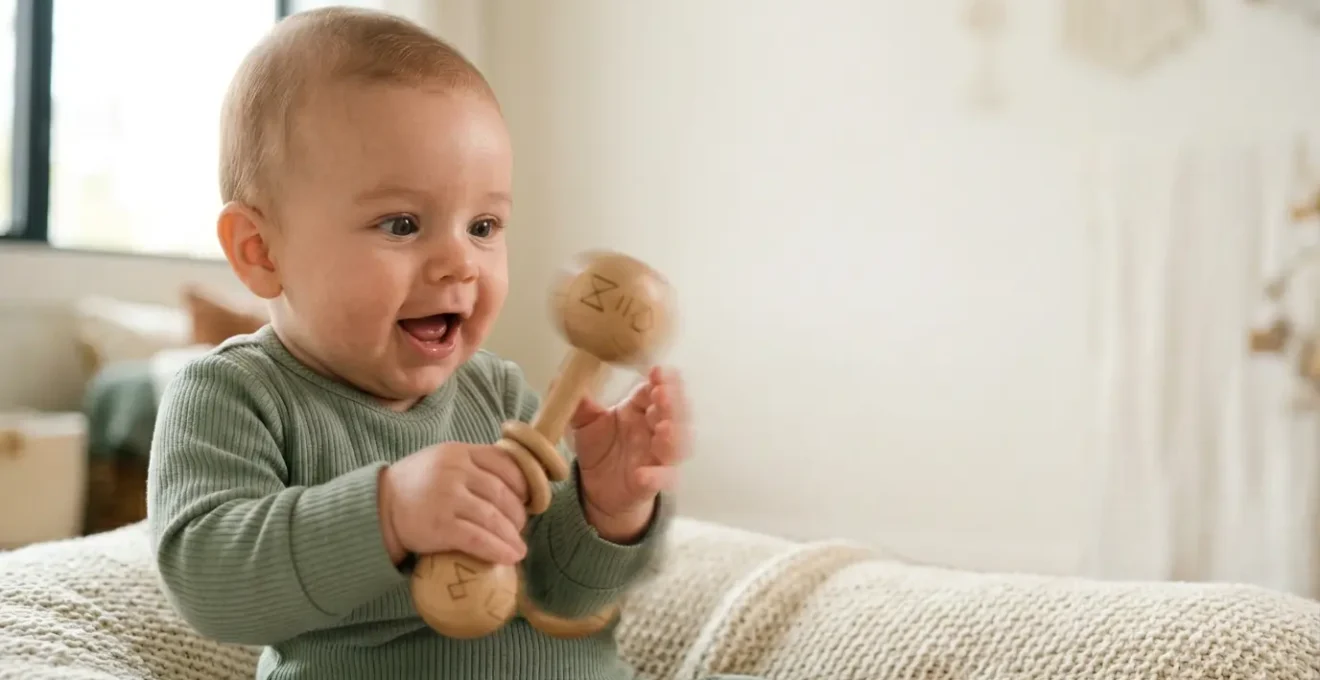
That moment your baby shakes a rattle and their eyes widen isn’t just cute; it’s the spark of a cognitive revolution.
- Simple, responsive toys teach your baby they are an agent of change, a core lesson that flashy, automatic toys can’t provide.
- This understanding of « cause and effect » is the fundamental building block for all future problem-solving, planning, and curiosity.
Recommendation: Shift your focus from buying « educational » toys to creating an environment where your baby can safely experiment and discover their own power to make things happen.
You’ve seen it. That moment of pure, unadulterated delight when your baby, after a series of random flails, manages to shake a rattle and it makes a noise. Their face lights up, a tiny gasp of surprise followed by a determined, focused effort to do it again. As a parent, you file this away as another adorable milestone. But what if that simple rattle shake is one of the most profound intellectual achievements of your baby’s first year? It’s a moment so significant, it’s akin to a scientist’s first successful experiment.
We often think that learning for babies is about absorbing information—colours, shapes, sounds. We fill their world with toys that sing, flash, and move on their own, believing we are enriching their minds. But we might be missing the most crucial element. The real learning isn’t passive; it’s active. It’s the dawning realisation, « I did that. My action caused that reaction. » This is the birth of intention, the first spark of personal agency that will fuel a lifetime of learning.
This article isn’t another list of the top ten toys to buy. Instead, it’s an invitation to see the world through your baby’s eyes—as a giant, fascinating laboratory. We’ll explore the monumental cognitive leap that is cause and effect, uncovering why the toys your baby must activate are infinitely more valuable than those that perform for them. We will see how this simple understanding snowballs into complex problem-solving and how even a game of peek-a-boo is a masterclass in physics. Get ready to see your little one not just as a baby, but as a budding cognitive architect, building their own brilliant mind one shake, tap, and giggle at a time.
This guide will walk you through the incredible journey of how your baby discovers their own power. Below is a summary of the key stages and concepts we will explore, showing how each small discovery builds towards a powerful understanding of the world.
Summary: The Cause-and-Effect Revolution
- Why the « I Made That Happen » Realisation at 4 Months Changes Everything?
- Which Button-Press, Pull-String, and Drop-Ball Toys Build Cognitive Connections?
- How Light Switches, Water Taps, and Kitchen Drawers Become Learning Tools?
- Why Toys That Do Things Automatically Teach Less Than Toys Baby Must Activate?
- How Cause-and-Effect Understanding Leads to « How Do I Get That Toy? » Problem-Solving?
- Which Toys Match the Palmer Grasp at 4 Months vs the Pincer Grasp at 10 Months?
- Why Every New Texture, Sound, and Smell Creates Neural Pathways in Your Baby’s Brain?
- Why Peek-a-Boo Becomes Hilarious at 6 Months: Your Baby Finally Understands You Still Exist?
Why the « I Made That Happen » Realisation at 4 Months Changes Everything?
Around the four-month mark, something incredible happens in your baby’s mind. The world shifts from a series of random, unconnected events to a place where their actions have consequences. This is the birth of the « agency spark » – the dawning realisation that “I can make things happen!” This isn’t just a minor development; it’s a seismic shift in perspective that forms the bedrock of self-awareness and learning. Before this, a jiggling toy was just a jiggling toy. Now, it’s a jiggling toy *because I moved my hand*. This transition from passive observer to active participant is the first step towards all future intentional actions, from reaching for a toy to solving a puzzle.
This cognitive leap requires an immense amount of brainpower. In fact, a significant portion of your baby’s energy is dedicated to this monumental task of brain development. This period is less about learning facts and more about figuring out the fundamental rules of physics and their own place within it. As the American Academy of Pediatrics highlights, once babies grasp this power, their path is set. According to their guidance on infant development, « Once they understand that they can cause these interesting reactions, they continue to experiment with other ways to make things happen. » Your baby becomes a tiny scientist, relentlessly testing hypotheses: « If I kick, does the mobile move? If I smack this, does it make a sound? »
This newfound understanding is deeply empowering. It teaches your baby that they are not helpless, but a force of change in their environment. Every successful experiment, no matter how small, reinforces this powerful message. This is why a simple rattle can be more engaging than a complex television show; the rattle responds to them, proving their agency, while the screen is indifferent to their existence. Celebrating this stage means recognising that your baby is not just playing, but conducting the most important research of their life: discovering themselves.
Which Button-Press, Pull-String, and Drop-Ball Toys Build Cognitive Connections?
Once your baby has discovered their power to influence the world, their play becomes more purposeful. They are now on a mission to test the limits of cause and effect, and the right toys can become powerful tools in their action-reaction laboratory. The best toys for this stage are not the most complex, but the most responsive. Think of a simple ball ramp, a pull-string toy that makes a sound, or a nesting cup that can be knocked over. Each of these offers a clear and immediate reaction to the baby’s input.
The key is direct feedback. When a baby pushes a button and a character pops up, they learn a simple, one-to-one relationship. When they pull a string and a bell rings, the connection is reinforced. These toys help solidify the neural pathways for understanding sequence and consequence. It’s crucial to distinguish these from passive, « entertainment » toys. A toy that plays music and lights up on its own might be distracting, but it teaches nothing about agency. The most valuable toys are the ones that do nothing until your baby acts upon them.

Interestingly, research suggests that when it comes to fostering deep cognitive development, less is often more. One study found that toddlers in environments with fewer toys showed more sustained attention and greater imagination. They didn’t just move from one stimulus to the next; they explored the full potential of each object. A single wooden ball can be rolled, dropped, banged, and hidden, offering dozens of experimental possibilities. This encourages deeper, more sophisticated play, turning a simple object into a versatile learning tool. The goal is not to have a room full of « cause-and-effect toys, » but to provide a few high-quality, open-ended items that invite your baby to be the cause.
How Light Switches, Water Taps, and Kitchen Drawers Become Learning Tools?
While carefully chosen toys are valuable, some of the most powerful learning tools in your home aren’t toys at all. Your baby’s « action-reaction laboratory » extends far beyond the playmat. Everyday household items offer a rich, multi-sensory landscape for experimentation. A light switch, for example, is the ultimate cause-and-effect object: one flick, and the entire room transforms from dark to light. Tapping a spoon on the highchair tray produces a satisfying ‘clack’, different from the ‘thud’ it makes on the wooden floor. These are all data points for your budding scientist.
The kitchen, with its fascinating collection of sounds and textures, is often a favourite lab. The rustle of a bag, the clatter of pans (safely supervised, of course), or the simple act of opening and closing a drawer provides endless opportunities for discovery. Even bath time becomes a physics lesson: splashing creates waves, a cup fills with water and can be emptied, a rubber duck floats while a washcloth sinks. Each of these mundane activities is a rich learning experience, teaching concepts like gravity, object properties, and volume in a tangible way.
The key to unlocking this learning is creating a « yes » space—a safe, baby-proofed environment where their curiosity can lead the way without constant intervention. Instead of saying « no, » you structure the environment so their explorations are safe. This doesn’t mean letting them have free rein of the house, but designating areas where they can safely touch, explore, and experiment with their surroundings. By seeing your home through their eyes, you can transform it from a place of restrictions into a dynamic and exciting learning environment where every texture and sound contributes to their growing understanding of the world.
Your Action Plan: Setting Up a Safe Exploration Zone
- Remove potential hazards and baby-proof the space thoroughly, covering outlets and securing heavy furniture.
- Include different textures on the floor, such as a soft rug, a cool tile area, and a smooth wooden surface for varied sensory input.
- Ensure there are sturdy, low objects your baby can safely use to pull themselves up on when they are ready.
- Offer a « treasure basket » of safe, varied household objects: a wooden spoon, a silicone whisk, large, smooth shells, or different textured fabrics.
- Rotate the items in the treasure basket and play area regularly to maintain interest and offer new opportunities for discovery.
Why Toys That Do Things Automatically Teach Less Than Toys Baby Must Activate?
In the quest to give our babies the best, it’s tempting to reach for the most dazzling toys on the shelf—the ones with flashing lights, multiple songs, and self-propelling action. They promise to be « educational » and « stimulating. » However, there’s a growing body of evidence suggesting these automatic, « magic » toys may actually teach less than their simpler, baby-powered counterparts. The critical difference lies in the concept of contingency: for learning to occur, the effect must be contingent on the baby’s action.
A toy that sings and flashes at random is just noise. It doesn’t teach the baby anything about their own power. But a block that falls over *when pushed* or a button that squeaks *when pressed* provides a clear, understandable lesson in cause and effect. A pivotal study powerfully demonstrated this principle. Researchers found that toddlers learned causal relationships remarkably well when they observed a human acting on an object. However, when the objects appeared to move on their own, the children failed to learn the underlying causal link. The study concluded that watching human action was necessary for causal learning at this age. This highlights the profound importance of active engagement over passive observation.
This is where the distinction between intentional vs. automatic becomes crucial. An intentional toy is one that waits for the baby’s input. It is a tool. An automatic toy is a performer; it demands only an audience. While it might capture attention for a moment, it bypasses the « agency spark. » The baby isn’t the scientist conducting an experiment; they’re just watching a show. During a period of such explosive brain growth, every interaction matters. By choosing toys that require activation, we provide our babies with opportunities to be the director of their own play, reinforcing the powerful and essential message: « You are in control. You make things happen. »
How Cause-and-Effect Understanding Leads to « How Do I Get That Toy? » Problem-Solving?
The mastery of basic cause and effect is not the final destination; it’s the launchpad. Once your baby internalises the concept that « my action leads to a reaction, » they can start using this knowledge strategically. This is where simple play transforms into the first stages of true problem-solving. The question in their mind evolves from « What happens if I do this? » to « How can I make that happen? » This shift marks a significant milestone in their cognitive journey, moving from pure experimentation to goal-oriented action.
You’ll see this emerge around nine months. A toy is just out of reach, perhaps on a small blanket. A younger baby might simply cry in frustration. But the baby who understands cause and effect might look at the toy, then at the blanket, and realise that pulling the blanket (the cause) will bring the toy closer (the effect). This is not a random action; it’s a two-step plan. This is the very beginning of tool use and strategic thinking, built entirely on the foundation of their earlier experiments with pushing, pulling, and dropping. This process is fuelled by an astonishing rate of brain development; a baby’s brain forms over 1 million new neural connections per second, creating the intricate « neural blueprint » for future learning.
As the experts at ZERO TO THREE note, this is also tied to another developing concept: object permanence. They explain, « At around 9 months, babies are getting better at understanding cause and effect: ‘I push the button to make the music play.’ They are also starting to understand that the things they can’t see still exist. » These two ideas work in tandem. Because they know the toy still exists even if it’s partially hidden, they are motivated to figure out a plan to retrieve it. Every time your baby successfully solves one of these mini-puzzles, their confidence and problem-solving skills grow, setting the stage for a lifetime of curiosity and creative thinking.
Which Toys Match the Palmer Grasp at 4 Months vs the Pincer Grasp at 10 Months?
A baby’s ability to experiment with cause and effect is directly linked to their physical development. The way a 4-month-old explores an object is vastly different from a 10-month-old, and understanding this progression allows you to provide the right « tools » at the right time. It’s all about the grasp. A young infant primarily uses the palmer grasp, a reflexive, whole-hand clutch. Their experiments are broad and powerful: grabbing, shaking, and banging objects to see what happens. Large, lightweight rattles or soft, textured balls are perfect for this stage.
As they grow, their fine motor skills refine. They move through a transitional phase of « raking » objects towards them with their fingers. Then, around 10 months, a developmental miracle occurs: the pincer grasp. This is the precise opposition of the thumb and forefinger, a uniquely human skill that opens up a whole new world of detailed investigation. Now, they can poke tiny buttons, pull small flaps in a book, and pick up individual crumbs of food. Their cognitive experiments become more focused and analytical, asking not just « Am I the cause? » but « How can I manipulate the details? »
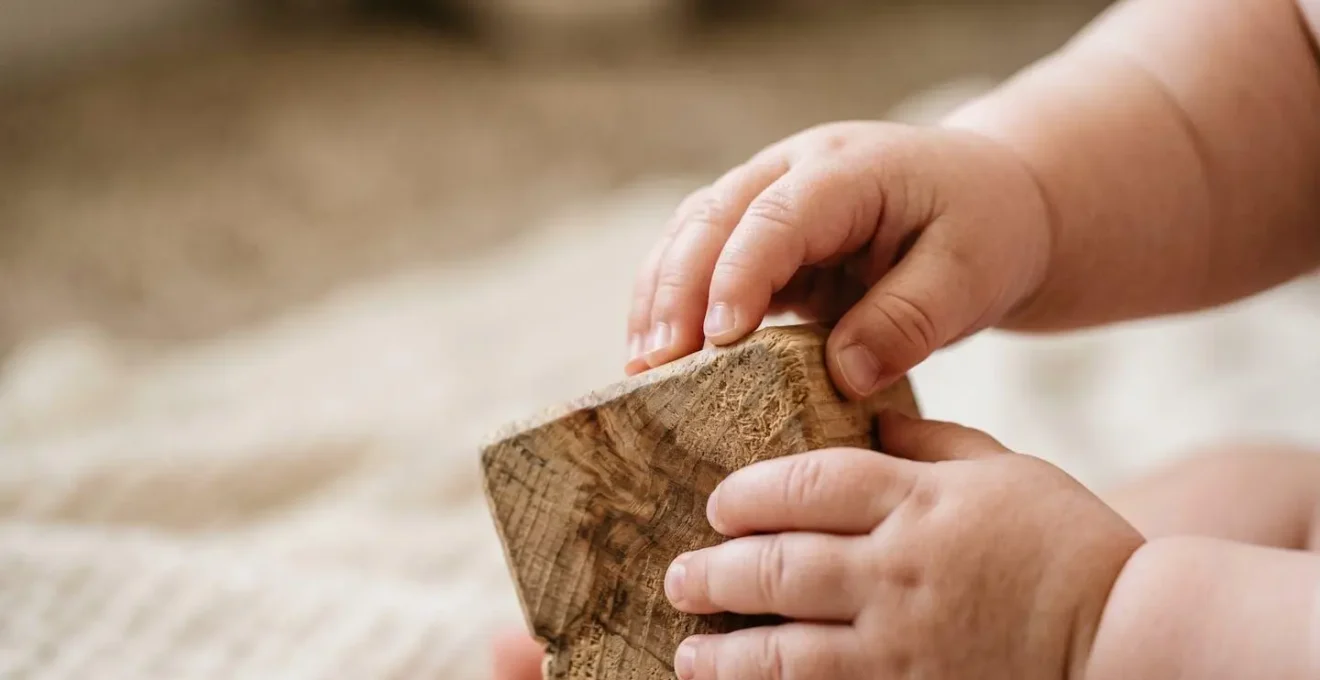
Matching the toy to the grasp is essential for avoiding frustration and encouraging exploration. A shape sorter is useless to a baby who can only bang it with their whole hand, but it’s a fascinating puzzle for a baby who can precisely pick up, turn, and post the shapes. The following table breaks down this progression, linking physical actions to the cognitive questions your baby is trying to answer.
| Grasp Type | Age Range | Physical Action Unlocked | Appropriate Toys | Cognitive Experiment Enabled |
|---|---|---|---|---|
| Palmer Grasp | 4-6 months | Whole-hand grasping, shaking, banging | Large rattles, soft blocks, textured balls, lightweight wooden spoons | « Am I the cause? » – Testing basic cause-and-effect with whole-object manipulation |
| Transitional Grasp | 7-9 months | Raking with fingers, transferring objects | Nesting cups, stacking rings, medium-sized blocks | « How do objects relate? » – Exploring spatial relationships and object properties |
| Pincer Grasp | 10-12 months | Precise thumb-finger opposition, poking, twisting, pulling small items | Shape sorters, pop-up toys with small buttons, textured books with flaps, small food pieces | « How can I manipulate details? » – Fine-tuned analysis and problem-solving with precision |
Why Every New Texture, Sound, and Smell Creates Neural Pathways in Your Baby’s Brain?
Your baby’s brain is not just a smaller version of an adult brain; it’s a dynamic construction site. And the primary building materials are sensory experiences. Every time your baby feels the rough texture of a carpet, hears the crinkle of a leaf, sees a vibrant colour, or smells a new food, their brain is firing up and forging new connections. This is the process of building the neural blueprint—the intricate network of pathways that will form the foundation for all future thinking, learning, and feeling.
The importance of this sensory input cannot be overstated. A young child’s brain is uniquely primed for this kind of learning, a state sometimes called « synaptic exuberance. » This simply means their brains are creating connections at an explosive rate. Research confirms that providing a rich sensory environment during this period has a direct impact on cognitive development. A compelling study comparing multi-sensory and traditional toys found that children exposed to rich visual environments with varied textures and sounds exhibited enhanced pattern recognition and problem-solving skills. The synergy between the senses—how a sound connects to a texture, or a sight to a smell—is what builds a complex and robust understanding of the world.
This is why simple, real-world experiences are often more valuable than structured « learning activities. » A walk in the park offers a symphony of sensory input: the feeling of a breeze, the sight of sunlight filtering through leaves, the sound of birds, the smell of damp earth. This is not just a pleasant outing; it’s a high-impact brain-building session. It’s an opportunity for your baby’s brain to do what it does best: take in raw data from the world and weave it into a coherent model of reality. Your role as a parent isn’t to be a formal teacher, but a « sensory curator, » thoughtfully exposing them to a safe and diverse range of experiences that will fuel their developing mind.
Key Takeaways
- Your baby is an active scientist, and cause-and-effect play is their first and most important experiment.
- Toys that require your baby’s action to work are far more educational than passive, automatic toys.
- Everyday household items and simple, open-ended toys often provide the richest learning opportunities.
Why Peek-a-Boo Becomes Hilarious at 6 Months: Your Baby Finally Understands You Still Exist?
There’s a magical period, around six to eight months, when a simple game of peek-a-boo transforms from a mild curiosity into the most hilarious event of the day. Those peals of laughter aren’t just a sign of a happy baby; they are the sound of a major cognitive breakthrough. The humour in peek-a-boo comes from the brand new understanding of a concept called object permanence. This is the principle that things (and people!) continue to exist even when you can’t see them.
For a younger infant, « out of sight » is literally « out of mind. » When you hide your face behind your hands, you have, in a very real sense, vanished. Your reappearance is startling, perhaps even a little confusing. But for the older baby who is beginning to grasp object permanence, the game has a narrative. They know you are still there. The game is no longer about a mysterious disappearance and reappearance; it’s about the tension and release of a predictable sequence. They can anticipate your return, and the confirmation of their prediction is deeply satisfying and, apparently, hilarious. The incredible growth of their brain’s physical structure, where neuroimaging studies reveal that cortical surface area expands by 76% from birth in year 1, provides the hardware for this software upgrade.
The American Academy of Pediatrics describes this as a major discovery for infants. Peek-a-boo, along with games like hiding a toy under a blanket, are fundamental lessons in this principle. This new understanding is profoundly comforting. It’s the reason separation anxiety can begin to emerge around this time—they now know you exist elsewhere and can miss you. But it also fuels their problem-solving. If a ball rolls under the sofa, it’s no longer gone forever; it’s an object to be retrieved. Object permanence and cause-and-effect are the twin pillars of early physics, teaching your baby the fundamental rules of the world and their ability to act within it.
So, the next time your little one’s face lights up as they master a new skill, whether it’s making a rattle shake or finding you in a game of peek-a-boo, know that you are witnessing a true revolution. You are watching a cognitive architect at work, building the very foundations of their mind. Your role is not to teach, but to facilitate, observe, and most importantly, celebrate every single discovery. Start observing your little scientist today and enjoy the privilege of having a front-row seat to the greatest show on earth: the development of a human mind.