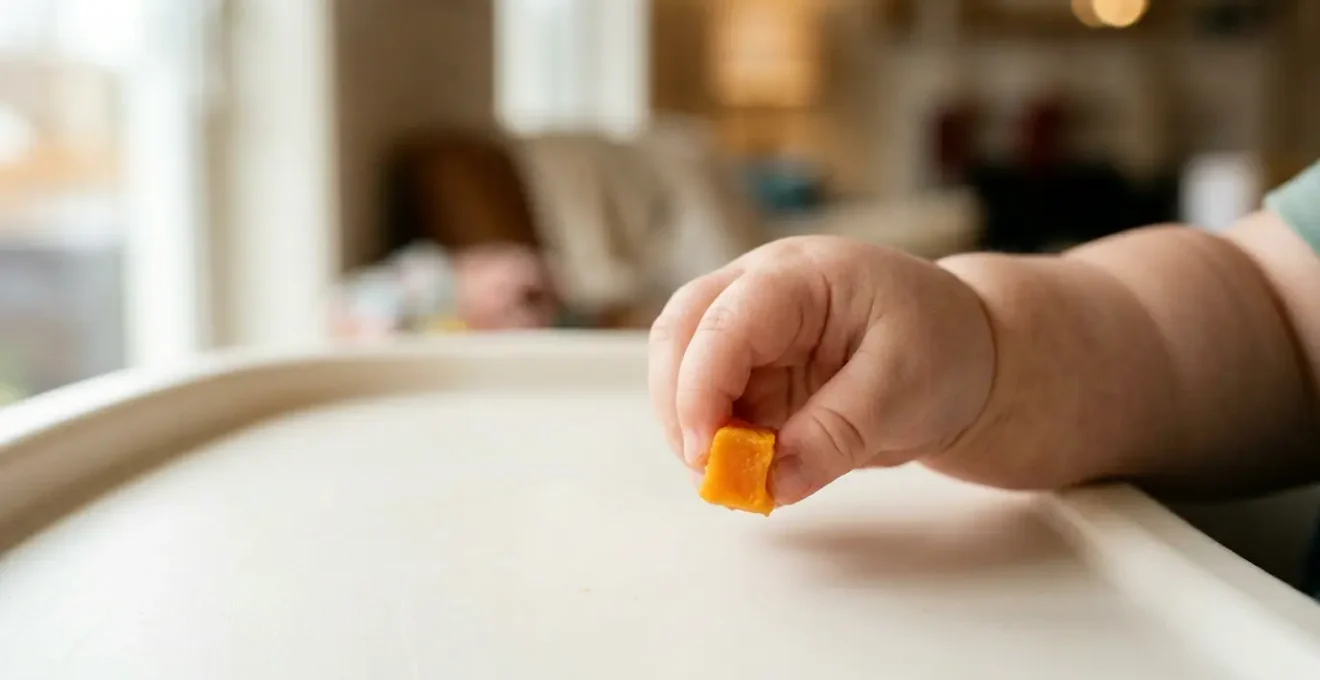
The shift from a clumsy whole-hand grab to a precise pincer grasp isn’t just a party trick; it’s the critical milestone that unlocks safe self-feeding and cognitive growth.
- This skill doesn’t appear overnight but follows a predictable sequence, starting with core strength and a « raking » motion.
- Over-reliance on spoon-feeding can unintentionally delay the development of essential fine motor and oral-motor skills needed for chewing and speech.
Recommendation: Instead of waiting for the pincer grasp to appear, actively support its development by understanding its prerequisites and offering progressively challenging, safe finger foods.
Watching your baby graduate from simply batting at toys to intentionally grabbing them is a thrill. As they approach nine months, you’re likely eager to introduce finger foods, picturing them daintily picking up peas and puffs. But often, the reality is a clumsy, whole-hand ‘palmer’ grab that smushes more food than it captures. It’s easy to see this and revert to the spoon, thinking they aren’t ready. The common advice is to simply offer small foods until they « get it, » but this overlooks a fundamental truth of child development.
The journey to the pincer grasp is not a trick to be learned but a sophisticated developmental sequence to be supported. It’s a story that begins not in the hands, but in the baby’s core. True fine motor precision in the fingers is impossible without a stable base in the shoulders and torso. This is why a baby must first master cruder, whole-hand movements before they can refine the delicate coordination of the thumb and forefinger.
This article will reframe your perspective. We will move beyond simply listing « pincer grasp activities » and instead illuminate the ‘why’ behind the ‘how’. We’ll explore the crucial, often-overlooked ‘raking’ phase, explain how the right toys and foods act as a physical therapist, and reveal why being a passive recipient of spoon-feeding can be a barrier to becoming an active, independent eater. By understanding this entire sequence, you can move from being an anxious observer to a confident developmental partner, celebrating each small step on the path to self-feeding mastery.
To guide you through this crucial developmental stage, this article is structured to build your understanding from foundational concepts to practical application. Below is a summary of the key areas we will explore to help you support your baby’s journey to fine motor independence.
Summary: Unlocking Your Baby’s Pincer Grasp Potential
- Why Your Baby Must Master the Raking Grasp Before the Pincer Grasp Emerges?
- How Cheerios, Peas, and Small Safe Objects Train the Thumb-Finger Coordination?
- Which Small Objects Are Safe for Pincer Practice vs Which Pose Choking Risk?
- Why Spoon-Feeding Every Meal Prevents Your Baby From Learning to Pick Up Food?
- When to Seek Assessment If Your 12-Month-Old Still Uses a Palmer Grasp for Everything?
- Why Watching You Eat and Waking at Night Are Not Signs Your Baby Needs Solids?
- Which Toys Match the Palmer Grasp at 4 Months vs the Pincer Grasp at 10 Months?
- Why Starting Solids Before 17 Weeks Can Damage Your Baby’s Immature Gut?
Why Your Baby Must Master the Raking Grasp Before the Pincer Grasp Emerges?
Before a conductor can lead an orchestra with the delicate flick of a baton, they must first have a strong, stable posture on the podium. The same principle applies to your baby’s fine motor development. The pincer grasp—that precise coordination of thumb and index finger—is the final flourish, but it’s built upon a foundation of larger, less refined movements. The most critical of these is the raking grasp. Around 6 months, you’ll see your baby use all their fingers like a rake to sweep objects into their palm. This isn’t a failed attempt at picking something up; it’s a vital developmental stage.
This « core-to-extremity » progression is a non-negotiable rule in infant development. An infant must first develop strength and stability in their trunk and shoulders before they can execute controlled movements in their arms, hands, and finally, their fingers. This concept is known as proximal stability for distal mobility.
Proximal stability refers to the strength and stability of the core and shoulders, which provides the support needed for fine motor precision in the hands and fingers.
– Transform Life Occupational Therapy, Proximal Stability Before Distal Mobility
The raking grasp strengthens the hand and teaches the brain the cause-and-effect of hand-to-object interaction. Only after this phase is mastered can the fingers begin to differentiate and work in opposition to the thumb. According to developmental milestone research, this sequence is predictable: the raking grasp appears around six months, paving the way for the pincer grasp to emerge between nine and ten months. Trying to rush this process is like trying to write a sentence before you know the alphabet.
How Cheerios, Peas, and Small Safe Objects Train the Thumb-Finger Coordination?
Once your baby has a stable core and has practiced with the raking grasp, their brain and body are ready for the next challenge: isolating the thumb and index finger. This is where specific foods and objects become less about nutrition and more about being the perfect equipment in a developmental gymnasium. The transition from a large, soft object to a small, firm one is a carefully calibrated workout for their developing dexterity.
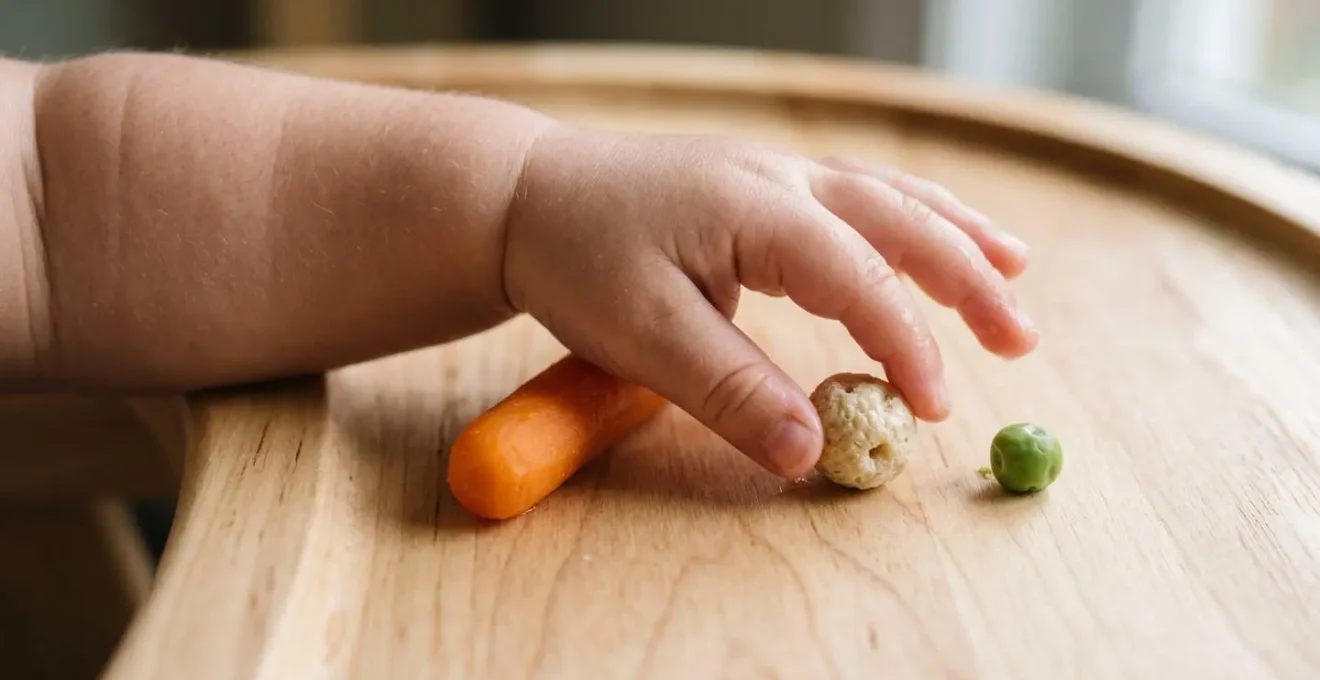
As the image beautifully illustrates, this is a game of progression. You start with larger, easy-to-grab items and gradually decrease the size as their skill improves. This systematic approach challenges their fine motor planning, visual tracking, and the all-important thumb-finger opposition. Each successful attempt builds neural pathways, making the movement more automatic and precise next time.
To structure this practice effectively, think in stages:
- Stage 1 (Early Practice): Offer larger, squishier items like steamed carrot sticks or banana pieces that can be trapped between their palm and fingers. This rewards the effort of bringing hand to mouth.
- Stage 2 (Intermediate): Progress to smaller items that require more precision, such as puffed cereal or small pieces of soft-cooked pasta. These can no longer be managed with a simple rake.
- Stage 3 (Advanced): Introduce items that roll, like peas, which demand a faster, more accurate grasp and a « scraping » motion to secure.
Beyond food, activities like « posting » small toys into an egg carton or Oball teach intentional release, the equally important other half of the pincer grasp skill. Encouraging them to poke holes in play-doh or press buttons on a toy isolates the index finger, a key player in the pincer team.
Which Small Objects Are Safe for Pincer Practice vs Which Pose Choking Risk?
The moment you introduce small finger foods, a new level of vigilance is required. While these items are essential for developing the pincer grasp, they also introduce the risk of choking. Understanding the difference between a challenging food and a dangerous one is paramount. It’s a sobering fact that 73% of nonfatal choking injuries occur in children under 5 years, making this a critical area of safety knowledge for parents.
The primary rule is to avoid anything that is small, hard, and perfectly round—the trifecta of choking hazards. These objects can completely occlude a child’s small airway. This includes whole nuts, whole grapes, hard sweets, and chunks of raw carrot or apple. However, size alone isn’t the only factor. The texture and shape are just as important.
Shape and compressibility matter just as much. A hard, round object (like a grape) is far more dangerous than a larger, softer object that can be squished and gummed (like a raspberry).
– Centers for Disease Control and Prevention, Choking Hazards Guidelines for Infant and Toddler Nutrition
So, what makes an object safe?
- Compressibility: The food should be soft enough that you can easily squish it between your thumb and forefinger. This means it will also yield to the pressure of a baby’s gums. Think ripe banana, avocado, or a well-steamed piece of sweet potato.
- Shape: Cut round foods like grapes and cherry tomatoes into quarters (lengthwise). Slice hot dogs lengthwise and then into small pieces. This eliminates the « plug » shape.
- Dissolvability: Many « baby puffs » and melts are designed to dissolve quickly with saliva, reducing the risk even if a larger piece breaks off.
The ultimate safety measure is constant, active supervision during all meals and snack times. A choking incident is silent and fast. Your presence is the most important safety tool you have.
Why Spoon-Feeding Every Meal Prevents Your Baby From Learning to Pick Up Food?
While spoon-feeding purees has its place, especially in the early days of starting solids, relying on it exclusively can inadvertently turn your baby into a passive recipient of nutrition rather than an active learner. When a baby self-feeds, they are doing far more than just eating; they are conducting a rich sensory experiment. They are learning about texture, temperature, and cause-and-effect (« If I squeeze this, it squishes! »). This exploration is crucial for cognitive development and for building a positive relationship with food.
More importantly, the act of self-feeding is a workout for the mouth. Picking up a piece of food, bringing it to the mouth, and managing it inside the oral cavity develops skills that spoon-feeding cannot replicate. One of the most critical is tongue lateralization—the ability to move food from the centre of the tongue to the molars for chewing. As feeding specialist Melanie Potock highlights, this has far-reaching implications.
Self-feeding forces the tongue to develop lateralization (moving food side-to-side for chewing), a critical skill for speech and managing more complex food textures later on.
– Melanie Potock, MA, CCC-SLP, 4 Ways to Help Babies Develop Their Pincer Grasp
When you exclusively spoon-feed, you place the food directly in the centre of the mouth. The baby learns a simple up-and-down « suckle » swallow pattern. By contrast, a baby managing a piece of avocado has to use their tongue to position it, their gums to mash it, and their oral awareness to swallow it safely. This oral-motor mapping is the direct precursor to managing a wider variety of foods and is foundational for clear speech production. By allowing them to get messy and explore, you are not just fostering independence; you are setting the stage for better eating and clearer talking in the future.
When to Seek Assessment If Your 12-Month-Old Still Uses a Palmer Grasp for Everything?
It’s important to remember that all babies develop on their own unique timeline. However, developmental milestones exist to provide a general framework. While some babies may develop a neat pincer grasp at 9 months, others might take until 11 or 12 months. The key is to look for progression. If your baby is still exclusively using a whole-hand palmer grasp for all objects by their first birthday, it’s a good time to pay closer attention and consider a conversation with your health visitor or GP.
According to pediatric development research, most babies should have a fairly well-developed superior pincer grasp (using the tips of the thumb and forefinger) by around 1 year of age. A persistent palmer grasp beyond this point doesn’t automatically mean there is a problem, but it does warrant a more structured observation. It could be a simple maturational lag, or it could be a subtle sign of a wider issue like low muscle tone (hypotonia) or an underlying neurological condition. An occupational therapist is the best-placed professional to make this assessment.
Before you make an appointment, gathering specific information will make your consultation much more productive. Don’t just say « he’s not using his fingers »; document the specifics.
Action Plan: Preparing for a Developmental Consultation
- Observe the Attempt: Is your baby ever *trying* to isolate their thumb and forefinger, even if it’s clumsy? Or is there no attempt at all? Note this down.
- Assess the Whole Picture: Look for other potential signs. Do they seem to have low muscle tone (« floppy »)? Do they strongly favour one hand over the other? Are other motor milestones like crawling or pulling to stand also delayed?
- Document with Dates: Keep a simple log. For example: « March 15 (13 months): Used whole palm to grab puffed cereal. Did not try to use fingers. »
- Capture Video Evidence: A short, clear video clip of your baby attempting to eat finger foods or play with a small toy is incredibly valuable for a professional.
- Prepare Your Questions: Go into the appointment with a clear goal. A great question is, « Given these observations, could we consider a referral to a paediatric occupational therapist for a fine motor skills evaluation? »
If you see no attempts at a pincer grasp by 12 months, or if an exclusive palmer grasp persists past 15 months, it is always best practice to schedule a consultation for peace of mind.
Why Watching You Eat and Waking at Night Are Not Signs Your Baby Needs Solids?
As your baby becomes more aware of the world, you’ll notice them tracking your every move—especially when it involves a fork moving towards your mouth. It’s easy to interpret this intense interest as a sign of hunger, a cue that they are « ready » for solids. Similarly, a sudden increase in night waking (the dreaded sleep regression) is often blamed on an empty tummy, prompting parents to introduce solids in the hope of getting more sleep. However, both of these beliefs are common developmental myths.
A baby watching you eat is demonstrating social learning and curiosity, not necessarily hunger. They are learning about their world by mimicking you, and eating is a fascinating social ritual. The same is true for night waking, which is most often linked to developmental leaps, teething, or changes in sleep cycles, not a caloric deficit. In fact, introducing solids, especially early on, is unlikely to solve sleep issues.
The nutritional science is clear. As the American Academy of Pediatrics points out, breast milk or formula is far more calorically and nutritionally dense, ounce for ounce, than the first solid foods like a few spoonfuls of vegetable puree. Starting solids won’t fill them up more; it will likely just displace the more calorically rich milk they actually need. True signs of readiness for solids are physical: the ability to sit up unsupported, good head and neck control, and the loss of the tongue-thrust reflex (pushing food out with the tongue).
Which Toys Match the Palmer Grasp at 4 Months vs the Pincer Grasp at 10 Months?
Just as you would select different gym equipment to train different muscle groups, you should choose toys that are specifically designed to meet your baby’s current developmental grasp. Providing a toy that is too advanced can lead to frustration, while one that is too simple offers no challenge for growth. The goal is to provide toys that perfectly match their ability, encouraging them to practice and refine their skills. A toy that is perfect for a 4-month-old’s palmer grasp is largely useless for a 10-month-old practicing their pincer.
This table outlines a clear progression, showing how different toys serve different developmental purposes at each stage of grasp development. Using this as a guide can help you rotate toys effectively to keep your baby challenged and engaged.
| Development Stage | Age Range | Grasp Type | Recommended Toys | Developmental Goal |
|---|---|---|---|---|
| Palmer Grasp | 4-6 months | Whole-hand grab | Soft rattles, crinkle-fabric books, Skwish toy, large textured balls | Connect grasping action with sensory reward (sound, texture) |
| Transitional Phase | 7-9 months | Raking to early pincer | Oball (easy to grab, invites finger poking), ring stackers, large knobbed puzzles | Bridge between palmar and precision grip, encourage finger isolation |
| Pincer Grasp | 10-12 months | Thumb-index precision | Wooden puzzles with knobs, piggy bank with large coins, board with switches/buttons, shape sorters | Demand pincer action to function, refine precision and intentional release |
Notice how the toys for the pincer grasp stage—like puzzles with small knobs or a piggy bank with coins—are impossible to operate without using a precise thumb-and-finger action. They demand the skill you want to encourage. This is a far more effective strategy than simply hoping the skill emerges on its own. By curating their play environment, you become an active participant in their fine motor journey.
Key Takeaways
- Grasp develops from the core outwards; shoulder and trunk stability (proximal stability) must come before finger dexterity.
- The clumsy « raking grasp » is not a failure but a necessary developmental stage that precedes the pincer grasp.
- Self-feeding is an active learning process that builds crucial oral-motor skills for chewing and speech that spoon-feeding cannot replicate.
Why Starting Solids Before 17 Weeks Can Damage Your Baby’s Immature Gut?
In the eagerness to see a baby achieve new milestones, it can be tempting to introduce solids early. However, official guidelines from global health bodies like the World Health Organization and the NHS are firm for a reason: introducing solids before a baby is developmentally ready (around 6 months, and certainly not before 17 weeks) can pose real risks to their immature systems.
A newborn’s digestive system is not a miniature version of an adult’s. Their gut lining is more permeable, often called an « open gut, » which is perfect for absorbing the immune-boosting components of breast milk but makes them more vulnerable to developing allergies or intolerances if complex foods are introduced too soon. Furthermore, the kidneys are not yet fully efficient at filtering waste products. As the WebMD Parenting Expert Panel explains, introducing solids, particularly high-protein ones, too early can be taxing.
This early introduction can place a high ‘solute load’ on a baby’s immature kidneys. This can lead to dehydration and put significant stress on their developing renal system. The physical signs of readiness—sitting unsupported, good head control, and loss of the tongue-thrust reflex—are the body’s way of signalling that these internal systems are mature enough to handle the new task of digesting food. Respecting these signals is the most reliable way to ensure a safe and positive start to their lifelong journey with food.
By understanding the ‘why’ behind each stage of grasp development, you can shift from worrying about milestones to confidently creating a safe and playful environment that fosters your baby’s natural progression towards self-feeding independence. Trust the process, provide the right opportunities, and get ready to celebrate that first, triumphant pincer grasp.