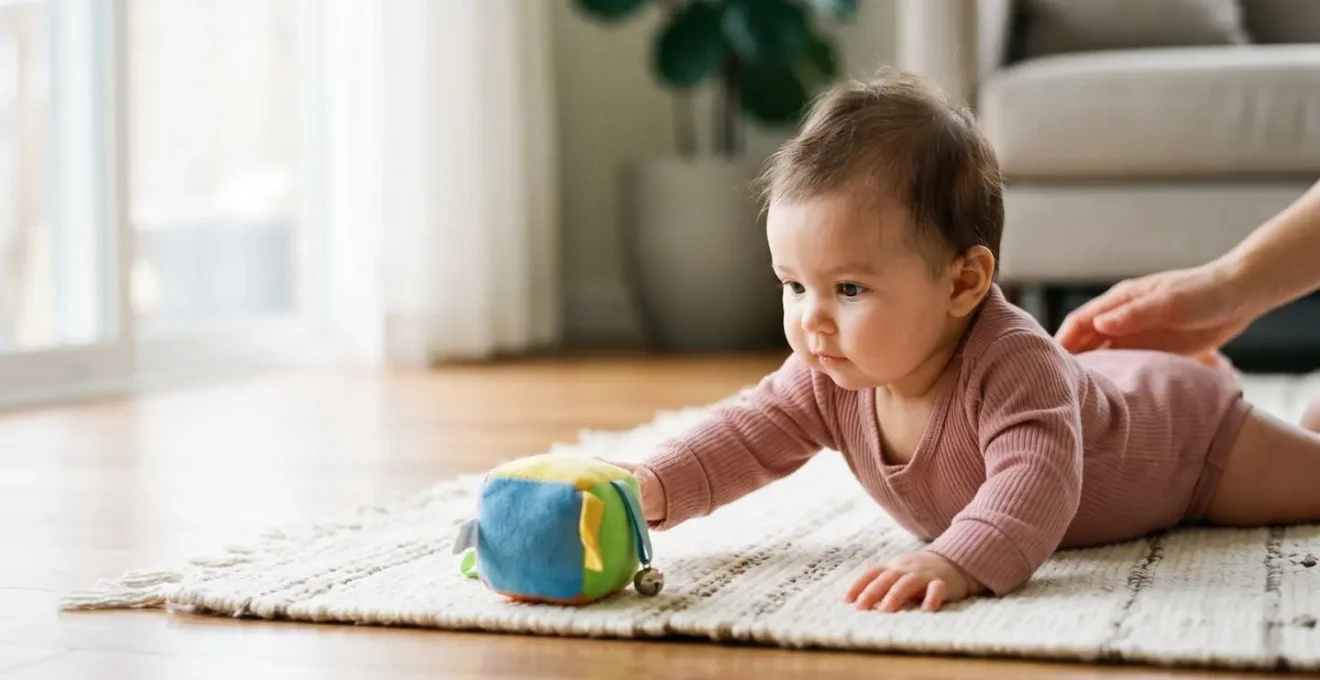
Contrary to popular belief, a baby’s journey to walking isn’t just about age; it’s a direct result of the muscle ‘training’ that only happens during floor time.
- Excessive time in seats and bouncers passively supports the body, preventing the core and hip muscles from doing the work needed for crawling and standing.
- Each milestone, like rolling and sitting, is a prerequisite that builds a specific ‘postural control system’ necessary for the next stage of development.
Recommendation: Aim for at least 30 minutes of cumulative, supervised floor time throughout the day, viewing it not as a chore, but as your baby’s most important workout.
As a parent, you want the best for your baby, and the array of modern bouncers, swings, and supportive seats seems to offer comfort and safety. It’s easy to believe these convenient tools are helping. But what if the key to building a strong, confident walker isn’t found in a piece of equipment, but on the simple expanse of your living room floor? Many parents worry about when their baby will hit milestones like sitting or walking, often comparing their child to others. We’re told « tummy time is important, » but the advice often stops there, leaving us to wonder what it’s really achieving.
The truth, from a physiotherapy perspective, is that motor development is a developmental cascade. Each skill physically builds the foundation for the next. Time spent in ‘containers’ is passive; the equipment does the work of supporting the baby’s body. Floor time is active; it forces the baby to engage and build the very core, neck, and hip muscles that are the architectural blueprint for every movement to come, from a steady head to their first independent steps. It’s not about banning bouncers, but about understanding the profound developmental cost of overusing them.
This guide reframes floor time from a simple activity into a crucial training programme. We will break down the precise sequence of development, explaining why skills must be learned in order. You will learn how to turn your home into a ‘movement landscape’ that encourages exploration, understand the real difference between helpful and harmful equipment, and gain the confidence to know when your baby’s timeline is perfectly normal versus when it might be time to seek advice. It’s time to shift the focus from *when* your baby walks to *how* you can empower them to build the strength to get there.
This article provides a complete roadmap for understanding and supporting your baby’s physical journey. Explore the sections below to see how each stage of development connects to the next, building a strong foundation for a lifetime of movement.
Summary: The Developmental Blueprint for Baby’s First Steps
- Why Does Your Newborn’s Wobbly Head Become Steady by Week 12 With the Right Support?
- Why Does Every Later Milestone Depend on Your Baby Mastering Head Control First?
- Why Must Rolling Happen Before Sitting, and Sitting Before Crawling?
- How Can You Set Up Your Living Room So Your Baby Wants to Move and Explore?
- Why Do 4+ Hours Daily in Swings, Seats, and Bouncers Weaken Your Baby’s Core?
- Baby Walker vs. Push Walker: Why Does One Delay Walking While the Other Helps?
- Why Is « Walking by 12 Months » a Myth and 9-18 Months Actually Normal?
- When Is Late Walking Just Individual Timing vs. When Does It Signal a Problem?
Why Does Your Newborn’s Wobbly Head Become Steady by Week 12 With the Right Support?
A newborn’s wobbly head is one of their most defining features, a clear signal of the muscular development that lies ahead. This initial lack of control is completely normal; babies are born with relatively large heads and underdeveloped neck muscles. The journey from a bobbing head to a steady gaze is the very first project in their gross motor development. This process is powered almost entirely by one key activity: tummy time. When placed on their stomach, a baby instinctively tries to lift their head, even for a moment, to look around or see your face. Each tiny lift is a ‘rep’ that strengthens the neck and upper back muscles.
By around 6 to 8 weeks, you’ll notice these efforts become more sustained. By 3 months, most babies can lift their head to 45 degrees, and the significant ‘head lag’ (the head falling back when you pull them to sit) starts to disappear. In fact, clinical research shows that head lag should be absent by 3 to 4 months of age. This mastery isn’t just about looking cute in photos; it’s about achieving the foundational stability required for every subsequent milestone. Without a stable head, the brain can’t get the reliable visual and vestibular (balance) information needed to understand its position in space, making skills like rolling and sitting impossible.
Of course, not all babies love traditional tummy time on a mat. If your little one protests, it’s important not to force it but to get creative. The goal is simply to get them off their back. Here are some effective alternatives:
- Tummy-to-Tummy: Lie on your back and place your baby on your chest. They will naturally lift their head to see your face.
- Football Carry: Carry your baby face-down, supporting their tummy with your forearm. This is a great way to build strength while on the move.
- Lap Soothe: Place your baby tummy-down across your lap while you sit, gently rubbing their back.
- Side-Lying: With support from a rolled-up towel behind their back, let your baby play on their side. This still engages neck muscles as they turn their head to look at toys.
Ultimately, these early weeks are about providing frequent, short bursts of opportunities for your baby to work against gravity. This consistent effort is what transforms a wobbly newborn into a baby with the strong, steady head control that serves as the bedrock for all movement to come.
Why Does Every Later Milestone Depend on Your Baby Mastering Head Control First?
Think of your baby’s motor development as building a pyramid. The wide, solid base of that pyramid is head control. Without it, the entire structure is unstable. Every more complex skill—rolling, sitting, crawling, and eventually walking—is built directly upon this first achievement. When a baby masters head control, they gain more than just a stable view of the world; they unlock a developmental cascade of neurological and muscular progress. A steady head allows for focused vision, which in turn motivates them to reach for objects. This reaching action begins to strengthen the shoulders and core.
As the NCBI StatPearls medical database highlights, this initial stage is critically important for neurological assessment:
Persistent head lag beyond age 4 months has been associated with poor neurodevelopmental outcomes.
– NCBI StatPearls Medical Database, Infant Head Lag – Clinical Review
This visual pyramid shows how one skill builds upon the next. Firmly planting hands during tummy time (foreground) strengthens the arms and core needed for supported sitting (middle ground), which in turn develops the balance and leg strength required for standing and walking (background).

Once head control is established, a baby can lie on their tummy and push up on their forearms, strengthening their chest and arm muscles. This is the precursor to rolling. They can look from side to side without losing balance, a key part of learning to shift their weight to initiate a roll. Similarly, sitting independently is impossible without a strong neck and upper back to hold the trunk upright. Postural control begins at the top and works its way down. Without a stable head, the core can’t properly engage to support the torso, and the baby will simply slump over. This sequential process is non-negotiable.
Therefore, focusing on those early head-lifting exercises is not just about one milestone. It’s about laying the essential groundwork for a skyscraper of future movements. Every minute of active floor time is an investment in your baby’s ability to confidently and capably explore their world.
Why Must Rolling Happen Before Sitting, and Sitting Before Crawling?
Motor development isn’t a checklist of skills to be acquired in any order; it’s a logical progression where each milestone prepares the body for the next. The sequence of rolling, then sitting, then crawling is a perfect example of this natural curriculum. Rolling, which typically happens between 4 and 6 months, is the first time your baby masters whole-body coordination. To roll from their tummy to their back, they must use their neck, arms, and core muscles together to initiate a weight shift. This action is a powerful workout for the oblique (side abdominal) muscles, which are crucial for trunk stability in sitting.
Once a baby can roll both ways, they have developed a foundational understanding of how to move their body as a single unit. This core strength is precisely what’s needed to achieve independent sitting. A baby who is propped into a sitting position before their core is ready will often slump, have a rounded back, and be unable to protect themselves if they topple. However, a baby who has mastered rolling has built the prerequisite strength to hold their torso upright, use their hands for balance (the « tripod » sit), and eventually sit and play freely. This usually solidifies between 6 and 8 months. Sitting then becomes its own postural control system, freeing the hands to explore objects and further refining balance.
Case Study: The Science of Sitting vs. Crawling
Early research highlighted how different postures unlock different abilities. A foundational study published in the National Center for Biotechnology Information found that babies who could sit independently were able to solve problems, like reaching around a barrier for a toy, weeks before they could solve the same problem from a crawling posture. This demonstrates that sitting and crawling are distinct balance control systems. Mastering the stability of sitting first provides a platform from which to learn the much more complex, dynamic balance required for crawling.
Finally, crawling emerges from the stability of sitting. While sitting, a baby learns to reach forward, placing their hands on the floor. From there, they rock back and forth, building strength and coordination in their hips and shoulders. This rocking is the training ground for crawling. Crawling itself, which often begins between 7 and 10 months, is a neurological marvel, requiring cross-lateral coordination (moving the opposite arm and leg together). This pattern strengthens the connection between the left and right hemispheres of the brain, which has benefits for future learning. Bypassing crawling means missing out on this critical stage of bilateral integration and shoulder and hip strengthening.
Forcing a baby into a position they aren’t ready for is like trying to build the second floor of a house without a foundation. By respecting this natural sequence and providing ample floor time, you allow your baby to build their body and brain in the logical, effective way nature intended.
How Can You Set Up Your Living Room So Your Baby Wants to Move and Explore?
The secret to encouraging movement is to create an environment that is not just safe, but enticing. Instead of just a flat, empty play mat, think of your floor space as a « movement landscape »—a carefully designed area that invites curiosity and motivates your baby to push, pull, roll, and reach. The goal is to make movement the most interesting option available. This doesn’t require expensive toys or elaborate setups; it’s about strategic placement and using what you already have to create gentle challenges.
Start by ensuring the foundation is right: a firm, flat surface. A blanket or play mat on the floor is ideal. Soft surfaces like beds or sofas are counterproductive, as they make it harder for a baby to push off and can be a safety hazard. Once the space is defined, the magic is in the setup. Place one or two highly engaging toys (think high-contrast, crinkly, or light-up) just beyond your baby’s current reach. This creates what’s called a « movement opportunity. » The toy shouldn’t be so far that it causes frustration, but just far enough to encourage a stretch, a pivot, or the beginnings of a forward shuffle. This is how reaching evolves into crawling.
Varying the terrain is another powerful strategy. Use firm sofa cushions, a rolled-up yoga mat, or even your own legs as small « hills » for your baby to navigate over or around. This not only makes the space more interesting but also provides varied sensory input to their hands, feet, and body (proprioception), which is vital for developing body awareness. Here are some actionable steps to create your movement landscape:
- Choose a firm, flat surface: A clean blanket or dedicated play mat on the floor is perfect. Avoid soft beds or couches where movement is difficult and unsafe.
- Strategic toy placement: Place a favorite toy just out of reach to motivate reaching, pivoting, and eventually, crawling.
- Get down at eye level: Your face is your baby’s favourite toy. Lying on the floor with them encourages head lifting and engagement.
- Create varied terrain: Use firm cushions or pillows to build a low-level obstacle course that challenges their balance and body awareness.
- Rotate play locations: Simply changing which way the play mat faces or moving it to a different part of the room encourages your baby to look around and turn their head in new directions.
Remember, your presence is the most motivating factor of all. Get on the floor with your baby, cheer on their efforts, and celebrate the small victories. By curating a stimulating environment, you’re not just providing a place to play; you’re acting as the architect of your baby’s physical development.
Why Do 4+ Hours Daily in Swings, Seats, and Bouncers Weaken Your Baby’s Core?
Baby swings, seats, and bouncers are often a parent’s best friend, providing a safe and content spot for baby while you make a cup of tea or answer an email. Used for short, supervised periods, they are perfectly fine. However, when a baby spends multiple hours a day in these « containers, » it can inadvertently lead to what physiotherapists call a ‘movement deficit’. The fundamental problem is that these devices promote passive positioning. The seat does all the work of supporting the baby’s trunk and head, meaning the baby’s own core muscles are not required to engage. They are, in effect, switched off.
Think of it like this: floor time is like a dynamic workout, constantly forcing the muscles to adapt and fire to maintain balance and initiate movement. Time in a container is like sitting in a supportive armchair; it’s comfortable, but it builds zero strength. When a baby’s core muscles are not regularly challenged, they remain weak. A weak core makes it significantly harder to achieve key milestones. It’s the core that provides the stability to sit up straight, the power to push up into a crawl, and the balance to pull to stand. Spending extensive time in a semi-reclined position can also contribute to tightness in the hip flexors and flattening of the back of the head (plagiocephaly).
The contrast with recommended active time is stark. For example, the NIH Safe to Sleep guidelines specify a goal of 15 to 30 minutes of total tummy time daily by the time a baby is just 2 months old. This active time is a direct investment in core strength. To balance the convenience of containers with your baby’s developmental needs, paediatric experts recommend a proactive approach. The goal is to make floor time the default and container time the brief exception.
The key is a simple shift in mindset: view floor time as your baby’s essential ‘work’ and container time as their brief ‘break’. By consciously limiting passive positioning and maximizing opportunities for free, active movement, you are giving your baby the most valuable gift for their physical development: the chance to build their own strength.
Baby Walker vs. Push Walker: Why Does One Delay Walking While the Other Helps?
In the world of baby gear, the term « walker » can be confusing, as it describes two vastly different products with opposite effects on development. Understanding the mechanical differences between a traditional seated baby walker and a modern push walker is crucial for parents wanting to support their child’s journey to walking. A seated walker, which the NHS and paediatric associations strongly advise against, is essentially a fabric seat suspended in a frame on wheels. While it may seem like it’s helping a baby « practice » walking, it’s actually teaching all the wrong things.
In a seated walker, the baby is passively supported by the seat and crotch strap. They often hang in the device, leaning forward and pushing off with their toes. This pattern does several detrimental things: it strengthens the calf muscles in an imbalanced way, promotes toe-walking, and completely bypasses the need for the baby to use their own core and hip muscles for stability. Because the wide base of the walker provides all the balance, the baby never learns to make the tiny, constant postural adjustments that are the essence of walking. They don’t feel their full foot on the ground, missing out on crucial sensory feedback needed for balance. Furthermore, they are a significant safety risk, giving babies the mobility to reach hazards or fall down stairs.
A push walker, on the other hand, is a developmentally appropriate tool—but only for a baby who is *already* pulling themselves up to stand and cruising along furniture. A push walker (like a small cart or trolley) requires the baby to be in an active standing position. They must engage their core, legs, and arms to pull up on it, stand, and then coordinate their steps to move it forward. The baby is in control of the balance and momentum, not the device. This provides a safe way to practice the dynamic balance and forward motion of walking while still building the correct muscle groups. The key is that the baby is doing 100% of the work to stay upright.
This table summarises the key developmental differences, based on an analysis of walker impacts on development.
| Feature | Seated Baby Walker | Push Walker |
|---|---|---|
| Body Position | Seated with legs dangling, creates passive forward-leaning posture | Upright standing position, requires active core engagement |
| Muscle Engagement | Weakens core and hip muscles, promotes toe-walking pattern | Strengthens core, legs, and postural control muscles |
| Foot Contact | Limited sensory feedback, inhibits proper foot arch development | Full foot contact (ideally barefoot) for balance and sensory input |
| Balance Development | External support prevents natural balance learning | Requires baby to actively manage balance and momentum |
| Appropriate Timing | Not recommended by pediatricians | Only for babies already pulling to stand and cruising |
| Safety Concerns | High accident risk, especially near stairs | Stable base when used on flat surfaces with supervision |
In short, a seated walker teaches a baby to rely on external support, while a push walker encourages them to build their own internal stability. When the time is right, a push walker can be a fun tool, but the best preparation for walking remains the unassisted, natural practice of pulling to stand and cruising on furniture.
Why Is « Walking by 12 Months » a Myth and 9-18 Months Actually Normal?
One of the most common sources of anxiety for new parents is the belief that a baby « should » be walking by their first birthday. This 12-month benchmark is a persistent myth that puts unnecessary pressure on both parents and babies. From a developmental perspective, the range for independent walking is incredibly wide and far more forgiving than popular culture suggests. The journey to walking involves a complex interplay of muscle strength, balance, coordination, and confidence, and every child assembles these components on their own unique schedule.
Large-scale studies provide a much more realistic picture. In reality, data from thousands of children shows that only about 25% are walking by 12 months. The 50% mark (the average) isn’t reached until 13 months, and 75% are walking by 14 months. The full, normal range extends from as early as 9 months to as late as 17 or 18 months. An « early » walker is not more advanced, and a « late » walker is not behind; they are simply following different, but equally valid, developmental paths. Some babies are laser-focused on motor skills, while others might be busy developing their fine motor or language skills first.
Before a baby takes their first independent step, they must master a series of pre-walking skills. These are the true indicators of readiness. The most important of these are pulling to stand and cruising—walking sideways while holding onto furniture. These activities are where the real work happens. Pulling up builds leg and core strength, while cruising teaches them to shift their weight from one foot to the other, a fundamental component of walking. A baby who is confidently cruising is on the perfect track to walking, regardless of their age.

Instead of focusing on the date on the calendar, observe your baby’s skills. Are they pulling up on everything? Are they confidently letting go with one hand to reach for a toy? Are they taking tentative steps along the sofa? These are the signs that walking is on the horizon. A baby who starts walking at 16 months but who has progressed steadily through these stages is developing perfectly normally.
Therefore, celebrate the cruising, applaud the wobbly attempts to stand, and give your baby the space and time to build their confidence. Their first steps will happen when their unique combination of strength, balance, and nerve is ready, and that timeline is perfectly theirs.
Key Takeaways
- Motor development is a sequence; skills like head control and rolling are non-negotiable foundations for sitting and crawling.
- Time in bouncers and seats is passive and doesn’t build the core strength babies need; floor time is an active workout.
- The normal range for walking is wide (9-18 months), and « walking by 12 months » is a myth that causes unnecessary stress.
When Is Late Walking Just Individual Timing vs. When Does It Signal a Problem?
While the range for normal development is wide, it’s also natural for parents to wonder where the line is between a baby taking their time and a potential developmental issue. Reassurance that « every baby is different » is helpful, but concrete signs can empower you to know when to relax and when to have a conversation with your GP or health visitor. The key is to look at the whole picture of your baby’s movement, not just the single milestone of walking.
A baby who is not yet walking at 15 or 16 months but is happily and capably pulling to stand, cruising along furniture, crawling efficiently, and showing interest in moving is almost certainly within the normal range of development. Their motor skills are clearly progressing. Further supporting this, a study of 220 children found that healthy babies in Switzerland began walking anywhere between 8.5 and 20 months, with no difference in their later motor or cognitive skills. This shows just how broad the « normal » spectrum truly is. Individual temperament also plays a huge role; some cautious babies prefer to master cruising perfectly before they dare to let go, while more daring personalities might take wobbly steps much earlier.
However, there are specific red flags that warrant a professional evaluation. These signs often point not just to a delay in one skill, but to an underlying issue with muscle tone, strength, or coordination. The absence of precursor skills is a significant indicator. For example, a 12-month-old who shows no interest in pulling themselves up to a standing position is more concerning than a 14-month-old who is cruising but not yet walking independently. It’s the overall pattern of progression that matters most.
Your Action Plan: Red Flag Checklist for When to Seek Evaluation
- Marked asymmetry: Notice if your baby consistently uses only one side of their body for movement or shows a clear strength difference between their left and right sides.
- Extreme muscle tone issues: Check for either extreme floppiness (hypotonia), where the baby feels like a ‘rag doll’, or excessive stiffness (hypertonia) with rigid, jerky movements.
- Persistent toe-walking: Observe if your baby walks exclusively on their toes long after the initial learning phase, especially if their calf muscles seem tight.
- Loss of previously acquired skills: Immediately evaluate any regression where your baby loses motor skills they had previously mastered (e.g., stops rolling or sitting).
- Not walking by 18 months: If your child is not walking independently by their 18-month check-up, it is standard practice to seek a pediatric evaluation.
Trust your instincts. You are the expert on your child. If you have a persistent concern about their movement patterns, it is always appropriate to seek a professional opinion. Early intervention can make a world of difference if there is an issue, and if there isn’t, a professional assessment can provide invaluable peace of mind.