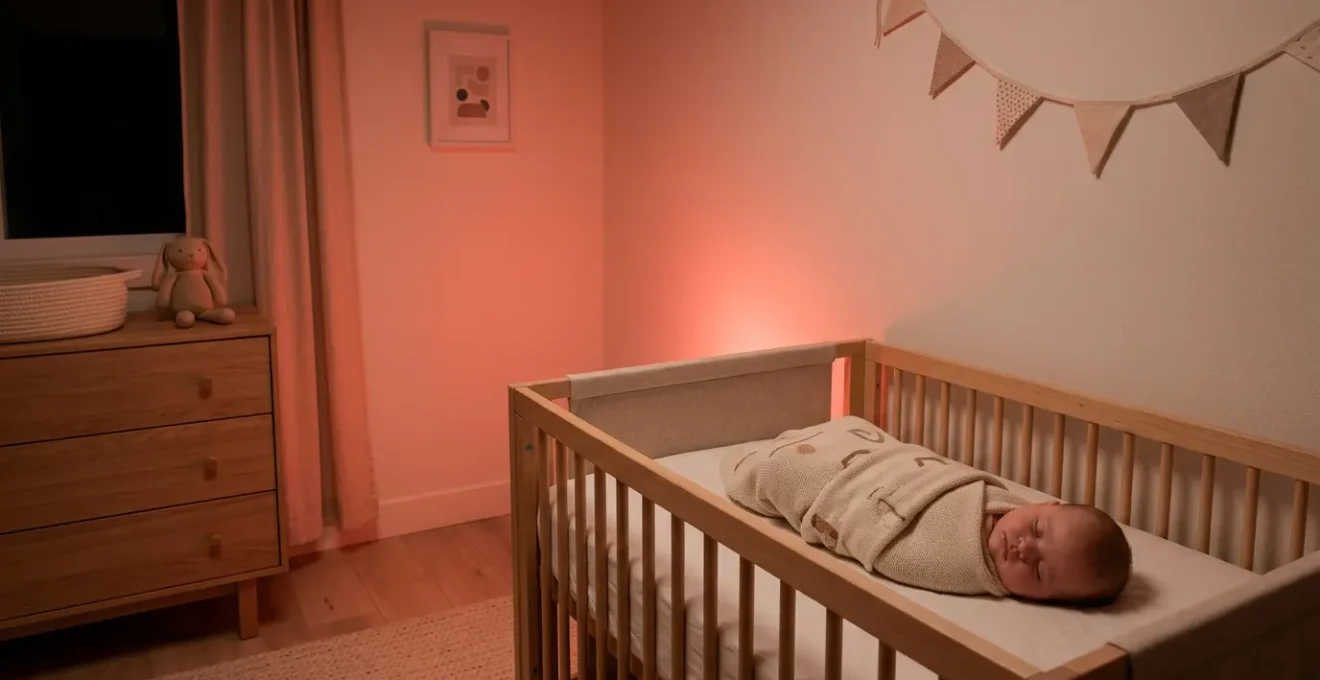
The key to surviving night feeds isn’t just about managing your baby’s sleep, but preserving your own melatonin from the destructive effects of bright, blue-rich light from your phone.
- Blue light actively suppresses melatonin, the sleep hormone, keeping you and your baby awake longer after a night feed.
- A dim, red-light environment (under 5 lumens) is scientifically proven to be the least disruptive, allowing for safe navigation without resetting the brain’s internal clock.
Recommendation: Swap your phone torch or bright plug-in for a strategically placed, dimmable red nightlight to transform chaotic nights into calm, non-disruptive routines.
That moment at 3 am: the baby stirs, and you reach for your phone, flicking on the torch to navigate the nursery. It feels like a quick, simple solution. Yet, an hour later, your baby is still restless, and you find yourself wide awake, staring at the ceiling. This frustrating cycle isn’t a failure of your parenting; it’s a predictable biological reaction to a hidden problem: light contamination. Many parents focus on sleep training techniques, but overlook the most fundamental environmental factor influencing both their baby’s and their own sleep—the colour and intensity of light.
The common advice to « use a nightlight » is often too generic to be truly effective. The market is flooded with options, from bright white plug-ins that promise safety but secretly sabotage sleep, to cute animal-shaped lamps that are more toy than tool. The truth is, not all light is created equal. The default choice—a phone screen or a standard white LED—emits a high concentration of blue light, the very same wavelength that tells our brains it’s midday and time to be alert. This article moves beyond the platitudes to explore the practical science of light physics for parents. We won’t just tell you red light is better; we’ll explain *why* it preserves the delicate hormonal balance of sleep.
This guide will equip you with a new level of understanding. We’ll delve into the specific mechanisms of melatonin suppression, compare the practical pros and cons of different nightlight types, and provide a clear blueprint for brightness, placement, and timing. By mastering these principles, you can create a nursery environment that works with your baby’s developing biology, not against it, turning stressful night feeds into efficient, peaceful moments that allow both of you to drift back to sleep with ease.
Explore the following sections to understand how to harness the power of light, transforming your nursery from a source of sleep disruption into a sanctuary of rest.
Summary: Why a Red Nightlight Preserves Your Baby’s Melatonin, While Your Phone’s White Light Destroys It
- Why Blue Light from Your Phone at 3am Keeps You Awake for an Extra Hour?
- Plug-in vs Rechargeable vs Smart Bulb: Which Nightlight Type Works Best for Night Feeds?
- Where to Place the Nightlight So It Illuminates the Cot Without Shining in Baby’s Eyes?
- Why Your 100-Lumen Nightlight Is Too Bright and Cutting Sleep Cycles Short?
- Why Your Newborn Has No Concept of Night Until Their Brain Develops at Week 8?
- How to Arrange Your Nursery So Night Feeds Take 10 Minutes Instead of 30?
- Why Your Baby Confuses Day and Night Until You Control the Light at 6 Weeks?
- When to Turn the Nightlight On and Off to Signal « Still Night-Time » to Your Baby?
Why Blue Light from Your Phone at 3am Keeps You Awake for an Extra Hour?
When your baby cries at 3 am, your instinct is to see and be seen to quickly. Using your phone as a torch or checking messages seems harmless, but it’s the equivalent of sending a direct signal to your brain—and your baby’s—that morning has arrived. The issue lies with a specific hormone: melatonin, the « vampire hormone » that only comes out in the dark and governs our sleep-wake cycles. The short-wavelength blue light that dominates smartphone screens and cool-white LEDs is a potent melatonin suppressant.
The science is strikingly clear. Your eyes contain photoreceptors that are particularly sensitive to blue light. When these receptors are activated, they send a powerful « wake up » message to the Suprachiasmatic Nucleus (SCN), your body’s master clock, which in turn halts melatonin production. Compelling research comparing red and blue LED light effects shows that after two hours, blue light kept melatonin levels suppressed, while red light allowed for significant recovery. This means that even a brief check of your phone can slam the brakes on your body’s sleep processes, making it incredibly difficult to fall back asleep after the feed is over. For your baby, whose circadian system is still developing, this blast of blue light is profoundly confusing and disruptive.
While features like « Night Shift » reduce some blue light, they are often insufficient. For a truly sleep-preserving strategy, consider these steps:
- Enable your phone’s grayscale accessibility setting, which removes stimulating colours entirely.
- Install a dedicated red-light screen filter app that is more aggressive than built-in settings.
- Reduce screen brightness to the absolute minimum and keep checks under 60 seconds.
- Hold the phone at arm’s length to decrease the intensity of light reaching your eyes.
Plug-in vs Rechargeable vs Smart Bulb: Which Nightlight Type Works Best for Night Feeds?
Once you’ve committed to eliminating blue light, the next question is practical: what tool is right for the job? The market offers three main types of nightlights, each suited to a different task within the nursery. Thinking in terms of « jobs to be done »—safe entry, diaper changes, and feeding—is more effective than searching for a single, do-it-all device. A multi-light strategy, or « zone lighting, » is the approach most sleep specialists recommend for creating an optimised, low-disruption environment.
The following table breaks down which nightlight type excels at each specific nursery task, helping you build a layered lighting system that provides the right amount of light exactly where and when you need it.
| Nightlight Type | Best For Task | Placement Strategy | Key Advantage | Key Consideration |
|---|---|---|---|---|
| Plug-in | Constant safety beacon near doorway | Low to ground near nursery entrance | Always-on reliability, no charging needed | Fire safety – keep away from fabrics and curtains |
| Rechargeable | Portable diaper changes | Kept at changing station, moved as needed | Complete mobility, no cord trip hazard | Low battery anxiety – requires charging every 1-2 nights |
| Smart Bulb | Automated sunset/sunrise routines | In existing lamp for feeding area | Programmable dimming and scheduling | Wi-Fi/EMF concerns – can be mitigated by placing 3+ feet from crib |
Case Study: The Three-Zone Lighting Strategy
As detailed by experts at leading baby sleep resources, a three-zone approach is highly effective. Zone 1 (Entry) uses a dim plug-in near the door at floor level for safe navigation. Zone 2 (Changing Station) has a portable rechargeable light providing task-specific light for diaper changes. Finally, Zone 3 (Feeding Area) uses a smart bulb in a lamp, dimmed to a low red setting. This strategy ensures each task has just enough light, preventing over-illumination of the entire room and preserving a sleepy atmosphere.
Where to Place the Nightlight So It Illuminates the Cot Without Shining in Baby’s Eyes?
You’ve chosen the perfect dim, red nightlight. But where you put it is just as important as what you bought. The most common mistake parents make is placing the light where it can shine directly into their baby’s line of sight or create a bright hotspot in the room. The goal is not to illuminate the cot, but to create a gentle, ambient glow that allows you to see the « action triangle »—the path between the door, the cot, and the changing table—without creating disruptive glare.
The solution is an elegant technique used by lighting designers: indirect or « bounce » lighting. Instead of pointing the light into the room, you position it low to the ground and angle it to face a neutral-coloured wall. The light bounces off the wall, diffusing and softening it, filling the space with a uniform, warm wash of red light. This eliminates harsh shadows and direct beams, creating a calm environment that’s bright enough for safe movement but dark enough to signal « sleep time » to the brain. This simple shift in placement is transformative.
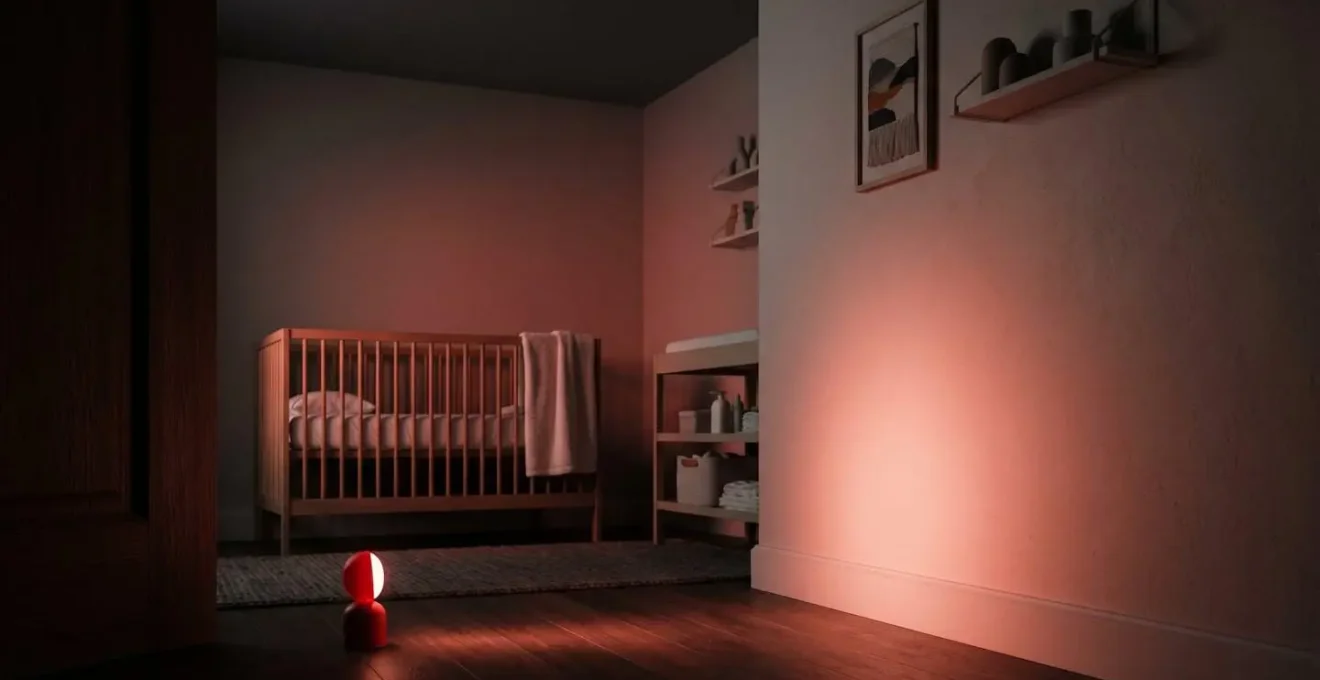
To perfect this, start by identifying your nursery’s three key points: the entrance, the cot, and the changing station. Your goal is to place the light low to the ground (around 6-12 inches high) at a point that provides even coverage across the paths between these zones. The ultimate test is practical: can you safely navigate the room and perform a full diaper change at 3 am without squinting or fumbling? If so, your placement is optimal.
Why Your 100-Lumen Nightlight Is Too Bright and Cutting Sleep Cycles Short?
In the world of nightlights, brighter is not better. A light that seems pleasantly dim in a fully lit store can feel like a searchlight in a pitch-black nursery at 3 am. Many commercially available nightlights, especially older or non-specialist models, can be as bright as 100 lumens, which is far too intense for a sleep environment. This level of brightness can be enough to suppress melatonin and disrupt the delicate architecture of a baby’s sleep cycle, preventing them from entering the deeper, more restorative stages of sleep.
So, how dim is dim enough? As a paediatric sleep specialist, the guidance is precise. For a light that will be on all night, you need an intensity of under 5 lumens. This is just enough light to prevent you from tripping over furniture but not enough to read by. For task-specific lighting, like a quick diaper change, you can go slightly higher, to around 15-20 lumens, but it should be turned off immediately after use. For context, most standard nightlights are well over this threshold. According to paediatric sleep consultants, sleep-safe lighting should be under 50 lumens, with the ideal for ambient light being under 5.
You don’t need a professional light meter to check this. Use these practical, real-world tests:
- The Book Test: Stand across the room. If you can easily read the text in a book, your nightlight is too bright for all-night use. You should barely be able to make out the words.
- The Dark Adaptation Test: Spend 10 minutes in a completely dark room, then enter the nursery. The light should feel subtle and gentle, not jarring or uncomfortably bright.
- The Pupil Test: If you happen to observe your baby when they naturally stir, their pupils should remain relatively wide (dilated). If their pupils constrict to small dots, the light is too intense.
Why Your Newborn Has No Concept of Night Until Their Brain Develops at Week 8?
If you’re feeling frustrated that your newborn seems to have their days and nights completely mixed up, take a breath. It’s not something you’re doing wrong; it’s a matter of brain development. For the first 6-8 weeks of life, a newborn literally has no biological concept of a 24-hour day. The internal master clock, a tiny region in the brain called the Suprachiasmatic Nucleus (SCN), is still under construction. It’s like the hardware is installed, but the software hasn’t been programmed yet.
In the womb, a baby’s rhythm is synced to their mother’s. After birth, their SCN must learn to synchronise with the external world, primarily through light cues. However, this system is not fully functional from day one. In fact, research on postnatal suprachiasmatic nucleus development reveals that while the foundational connections from the retina to the brain are forming within the first few days, the complex network required for a robust circadian rhythm takes weeks to mature. Your baby’s sleep is driven by sleep pressure (how long it’s been since they last slept), not by the time of day.

This early period is a critical window. As researchers in the field note, it’s a sensitive time for programming the circadian system. This is precisely why establishing a strong contrast between bright days and very dark nights is so vital from the beginning. You are providing the raw data—the clear distinction between light and dark—that your baby’s developing brain needs to build its internal clock correctly. As one team of researchers concluded, « The first few weeks of life may represent a sensitive window of circadian programming and organization where developing clocks are more susceptible to light exposure, » a point emphasized in the Journal of Physiological Anthropology.
How to Arrange Your Nursery So Night Feeds Take 10 Minutes Instead of 30?
A 3 am feed that stretches to 30 minutes isn’t just about feeding; it’s about the time wasted fumbling for wipes, searching for a clean burp cloth, or struggling to open a new pack of diapers in the dark. The key to slashing this time is efficiency, achieved by transforming your feeding and changing areas into a high-speed « cockpit. » This means having every single item you need for the entire feed-burp-change-resettle process pre-staged and within arm’s reach, eliminating any need for searching or decision-making.
The goal is to operate on calm, sleepy muscle memory. You create two primary cockpits: one at the changing station and one at the feeding chair. Each is a micro-environment of perfect organisation, illuminated only by its own dedicated, task-appropriate red light. This isn’t just about being tidy; it’s a strategic approach to minimise stimulation, reduce parental stress, and get both you and your baby back to sleep as quickly as possible. The focus is on friction reduction: every two-handed container is a point of failure, every step across the room a potential disruption.

By auditing your current process and setting up these dedicated zones, you reclaim precious minutes of sleep and transform a stressful chore into a smooth, predictable routine.
Your action plan: Night feed efficiency audit
- Audit Your Process: Time your next night feed from start to finish. Write down every action that wastes time, such as searching for items, fumbling with packaging, or walking between different areas of the room.
- Build the Changing Station Cockpit: Arrange diapers (pre-opened package), wipes (lid flipped), cream, and a spare outfit within an 18-inch radius. Add a dedicated red task light above the surface.
- Build the Feeding Chair Cockpit: Place a burp cloth, a water bottle for you, and a nursing pillow within arm’s reach. Use a second, very dim red light bounced off the wall behind you for ambient light.
- Practice Light Discipline: Do a dry run of the entire night-feed loop using only your red lights. The goal is to operate on « calm autopilot » while preserving your own sleepiness and your baby’s.
- Eliminate Friction: Replace or pre-stage any item requiring two hands to open. The mental load should be zero; the process should rely purely on muscle memory.
Why Your Baby Confuses Day and Night Until You Control the Light at 6 Weeks?
The reason your newborn sleeps soundly through a noisy daytime cafe but is wide awake at 3 am is that their internal clock is not yet set to the 24-hour day. As we’ve seen, the hardware is there, but it needs programming. The most powerful programming tool you have is light contrast. You must teach your baby’s brain the difference between day and night by making your days bright and your nights profoundly dark. This contrast is the primary external cue (or *zeitgeber*) that entrains their developing circadian rhythm.
Simply « keeping the lights on » during the day isn’t enough; the contrast needs to be significant. Powerful research on infant circadian rhythm establishment shows that infants exposed to cycled lighting—bright during the day (around 250 lux) and very dim at night (under 30 lux)—developed daily melatonin rhythms. In contrast, infants kept in constant moderate light showed consistently low melatonin levels. This demonstrates that it’s the *difference* between light and dark, not just the presence of light, that sets the clock. Your job in the first 6-8 weeks is to be the conductor of this light-dark orchestra.
To achieve this, you need a prescriptive light schedule. Daytime naps should be in a moderately lit room (blinds half-closed), teaching your baby that day sleep is different and shorter than night sleep. Nighttime must be a « light fast »—as dark as humanly possible, with only the dimmest red light used for navigation. Follow this prescriptive schedule to provide your baby’s brain with the clear, consistent data it needs to sync up with the world.
- 7:00 AM – ‘Light Feast’: Open all blinds fully. Expose your baby to bright, natural window light for 10-15 minutes to set their cortisol « wake-up » signal.
- Daytime Naps: Use a moderately lit room. Avoid a pitch-black environment, as this muddies the day/night distinction.
- 5:00 PM – Pre-Sunset Light: If possible, get another 10 minutes of exposure to natural outdoor light to reinforce daytime cues.
- 7:00 PM – ‘Sunset Routine’: Begin your « light fast. » All screens off. Switch to only dim red lights throughout the house.
- Bedtime: Baby goes to sleep in a pitch-black nursery, achieved with blackout blinds. The only light should be your ultra-dim red navigation light.
Key takeaways
- Blue light from phones and white LEDs actively suppresses melatonin, disrupting sleep for both parents and babies.
- A successful nightlight strategy uses multiple, task-specific lights: a dim plug-in for entry, a portable light for changes, and a smart bulb for feeding.
- The three keys to effective lighting are colour (red), intensity (under 5 lumens for ambient), and placement (indirect bounce lighting).
When to Turn the Nightlight On and Off to Signal « Still Night-Time » to Your Baby?
The final piece of the light mastery puzzle is timing. An on-demand approach—flicking a light on when the baby cries and off when you leave—introduces an abrupt environmental change that can be jarring and stimulating. A far more powerful strategy is to use light as a constant, passive signal. The goal is for your baby’s brain to form a simple, Pavlovian association: the presence of a dim, red glow equals sleep time. This means the light should ideally be on *before* the baby even enters the room for the night and stay on until the desired wake-up time.
This is where programmable smart lights truly excel, allowing you to automate a « sunset and sunrise » routine that provides powerful, consistent circadian cues without you having to do a thing. This consistency is the key to conditioning.
Case Study: The Automated Sunset/Sunrise Routine
As described by experts at leading parenting resources like Happiest Baby, parents can create a powerful « Sunset Routine » with a smart light. Thirty minutes before bedtime, the light gradually fades up from off to a dim red glow. This signals the transition to night. The red light then remains on at an ultra-low, constant brightness all night. At the designated wake-up time (e.g., 7:00 AM), the light slowly fades out completely, coinciding with natural morning light. The baby’s brain learns that the presence of red light means sleep, and its absence means it’s time to wake. This automated consistency removes the disruptive shock of a sudden light change.
By treating the red nightlight not as an emergency lamp but as a constant environmental state, you create a powerful sleep cue that becomes more effective over time. As renowned sleep consultant Kim West, The Sleep Lady, notes in a piece for Baby Shusher, « Red light is an easy addition to bedtime routines. It doesn’t overstimulate infants, which is key when trying to create an environment that encourages restful sleep. » The light becomes part of the sleepy landscape, as predictable and reassuring as the cot itself.
By implementing these science-backed lighting strategies, you can take control of your nights, transforming them from a chaotic battle for sleep into a period of calm, efficient care that supports the rest of the entire family.